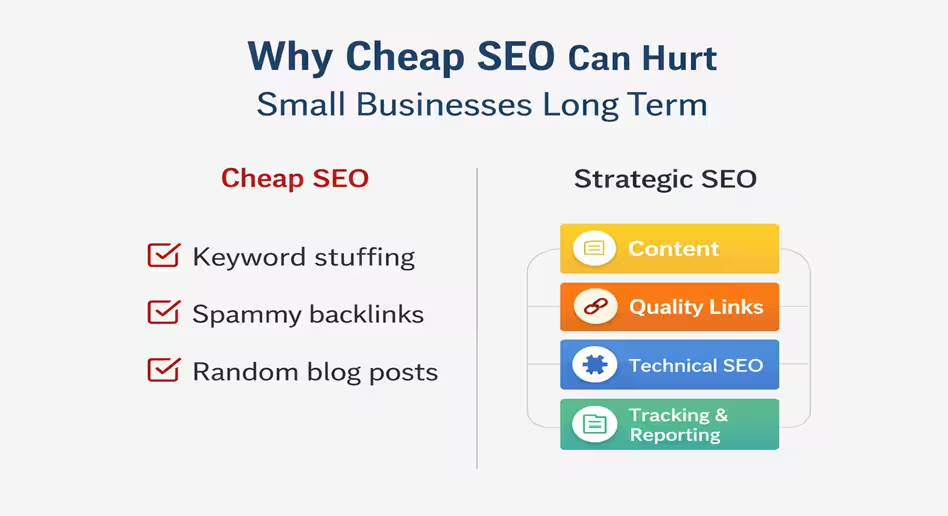
Why Cheap SEO Packages Fail for Small Businesses
For most small businesses, marketing budgets are tight. Every investment must justify itself. When you see a cheap SEO package promising first-page rankings, it seems attractive. More traffic and leads at a low monthly cost add to the appeal. It feels like a smart, low-risk decision.
On the surface, it makes sense. If SEO works, why not buy the lowest-priced option and test it?
The problem is not price alone. The problem is structure.
There is a major difference between cheap and affordable. Affordable SEO focuses on prioritising the most important work within a realistic budget. Cheap SEO often removes the very components that make SEO effective in the first place. This is where understanding the difference between affordable SEO services and low-cost shortcuts becomes critical.
Small businesses usually discover the difference only after several months of little progress.
What Small Businesses Usually Expect from Cheap SEO
When a small business invests in SEO, expectations are straightforward and reasonable. They expect:
- Their website to appear higher in search results
- More targeted visitors
- More calls, form submissions, or sales
- Clear monthly progress updates
These expectations are not unrealistic. SEO can absolutely deliver these outcomes. However, realistic progress depends on structured execution and clear reporting. Businesses that invest in monthly SEO packages often expect steady, measurable improvement, but that only happens when the work includes depth and prioritisation.
What Cheap SEO Packages Typically Include
Cheap SEO packages are structured to reduce labour hours, manual work, and strategic depth. That is how costs are kept low.
When the monthly price is very low, the provider must simplify the process. That usually means removing custom strategy and replacing it with standardised tasks.
Most cheap SEO packages rely on:
- Pre-defined checklists instead of custom audits
- Fixed deliverables regardless of website condition
- Automation instead of manual optimisation
- Volume instead of quality
A custom SEO strategy would prioritise fixing structural issues before scaling content or links. This is especially important for businesses comparing SEO packages for small businesses without fully understanding what is included.
Basic Keyword Targeting
Most low-cost SEO packages begin with a short list of primary keywords. These are usually broad, high-volume phrases such as:
- SEO services
- Digital marketing
- Website design
- Local business services
At first glance, this seems logical. These keywords appear relevant and attractive. They often show higher search volume in keyword tools, which makes them look valuable. The issue is not keyword research itself. The issue is depth and realism.
Broad keywords are usually dominated by:
- Established agencies
- High-authority domains
- Large marketing platforms
- Businesses with strong backlink profiles
When a small business with limited domain authority tries to rank for the same terms, the competition gap is significant. Even with consistent optimisation, progress can be extremely slow.
In many cheap SEO packages, keyword research does not go beyond surface-level metrics. There is often limited:
- Competitor gap analysis
Understanding what competitors are ranking for and where realistic entry points exist. - Search intent evaluation
Identifying whether users are looking for information, comparison, or immediate purchase. - Long-tail targeting
Focusing on more specific queries with lower competition and clearer intent. - Content clustering strategy
Building supporting pages that strengthen authority around a core topic.
Without this deeper analysis, keyword targeting becomes generic rather than strategic.
For example, targeting “SEO services” may look impressive in a report. However, targeting a more specific phrase such as “technical SEO support for small business websites” may be more realistic and commercially relevant in the short term.
Broad keyword targeting often creates frustration for small businesses. Rankings do not improve quickly because the website is competing in a space where authority has been built over years.
Effective keyword strategy for small businesses requires prioritisation. It requires identifying where momentum can realistically be gained before moving toward more competitive terms. When keyword selection lacks depth and context, SEO becomes an uphill battle instead of a structured growth process.
This is why many businesses move from cheap SEO toward more structured affordable SEO services for small business models that prioritise achievable targets first.
Automated or Template Content
Content creation is one of the most time-intensive parts of SEO. Researching topics, understanding search intent, structuring pages, writing clearly, and optimising properly all require skill and effort. To keep costs low, many cheap SEO packages rely heavily on automation or rigid templates.
This usually means:
- Reusing the same article structure for every client
- Producing short, surface-level blog posts
- Generating content with minimal editing
- Slightly rewriting competitor pages
- Adding keywords into existing pages without improving clarity
At first, this may look productive. Pages are published regularly. Word count increases. The website appears more active.
However, search engines do not reward activity alone. They evaluate usefulness, depth, and originality.
Automated or template-driven content often lacks:
- Clear alignment with search intent
- Unique insights or perspective
- Proper internal linking structure
- Context tailored to the specific business
- Logical content hierarchy
For example, two different small businesses in the same industry should not have identical blog structures with only minor wording changes. Their audience, competition level, and positioning are different. Content should reflect those differences.
Another issue with templated content is repetition. If every article follows the same format without expanding topical authority, search engines may see the website as shallow rather than authoritative.
Strong SEO content for small businesses typically requires:
- Targeted problem-solving topics
- Supporting content clusters
- Depth within a specific niche
- Consistent reinforcement of expertise
Automation can support efficiency, but it cannot replace strategic thinking.
When content is created purely to fill space or meet monthly quotas, it may increase page count but fail to build real authority. Over time, this results in websites with many indexed pages but little meaningful organic growth.
For small businesses, quality matters more than volume. One well-structured, intent-driven article often provides more long-term value than several generic posts published without strategy.
Low-Cost Link Building
Link building is one of the strongest ranking signals in search engines. High-quality backlinks act as trust signals. They indicate that other websites consider your content credible and worth referencing.
However, earning quality links takes time, outreach, and relationship building. It requires identifying relevant websites, pitching useful content, and sometimes creating assets worth linking to. This process cannot be automated easily.
To keep costs low, many cheap SEO packages rely on scalable link tactics instead of strategic link acquisition.
Common low-cost link methods include:
- Bulk directory submissions
- Low-quality business listings
- Blog comment links
- Article submission sites
- Private blog networks
- Paid links from unrelated websites
These tactics increase backlink count quickly. In reports, it may look impressive. The number of referring domains rises. The link profile appears to grow.
The problem is quality and relevance.
Search engines evaluate links based on:
- Domain authority and trust
- Relevance to your industry
- Editorial placement
- Natural anchor usage
- Link context within the page
A link from a respected industry-related site carries far more weight than dozens of generic directory listings.
Low-cost link building often focuses on volume rather than relevance. Over time, this creates a backlink profile that lacks depth and authority. In competitive markets, such links rarely move rankings.
In some cases, excessive low-quality links can even create long-term instability. Algorithm updates frequently target unnatural link patterns. While not every weak link causes penalties, a pattern of artificial linking reduces overall trust.
For small businesses, sustainable link building typically involves:
- Local industry mentions
- Relevant niche blog features
- Business partnerships
- Content-driven outreach
- Authoritative citations
These methods require planning and manual effort. They do not scale cheaply.
When link building is treated as a numbers game instead of a credibility-building process, SEO growth becomes unstable. The website may accumulate links but fail to build genuine authority.
For small businesses investing in SEO, understanding how links are earned is more important than how many links are reported each month.
Basic Reporting
Reporting is often used to demonstrate activity. In many cheap SEO packages, monthly reports include:
- Keyword ranking positions
- Organic traffic numbers
- Number of backlinks created
- A list of completed tasks
At first glance, this seems transparent. The business receives a document every month and sees measurable data. However, reporting without interpretation does not equal strategy. The issue is not that metrics are shown. The issue is what those metrics actually mean.
For example, ranking improvements for low-intent keywords may look positive in a report but generate no real leads. Similarly, a small traffic increase may not translate into inquiries if the website is not optimised for conversion.
Basic reporting often focuses on surface indicators:
- “You moved from position 18 to position 12.”
- “Traffic increased by 5%.”
- “20 backlinks were built this month.”
What is often missing is context:
- Which keywords are commercially relevant?
- Which pages are converting?
- Which improvements directly influenced performance?
- What adjustments are needed next month?
Without this analysis, small businesses see numbers but do not understand progress.
Another limitation of basic reporting is the absence of long-term perspective. SEO performance fluctuates. Rankings move up and down. Traffic changes based on seasonality and competition. A single month’s data rarely tells the full story.
Effective reporting should connect actions to outcomes. It should explain:
- Why specific tasks were prioritised
- What impact those tasks are expected to have
- How current performance compares to realistic benchmarks
- What the next strategic focus will be
Cheap SEO reporting often measures activity rather than impact. Sustainable SEO reporting measures direction and momentum. For small businesses, clear reporting should reduce confusion, not create it. It should help decision-making, not simply justify the monthly fee. Understanding the difference between data and insight is critical when evaluating any SEO package.
Reporting is often used to demonstrate activity. In many cheap SEO packages, monthly reports include rankings, traffic numbers, and backlink counts.
However, reporting without interpretation does not equal strategy.
If you want to understand what meaningful reporting looks like, reviewing a proper SEO report for small businesses helps clarify the difference between surface metrics and actionable insights.
What Cheap SEO Packages Often Leave Out
The most significant weaknesses in cheap SEO packages are not always visible. The missing elements are usually structural, and that is where most long-term failures begin.
Search engine optimisation is layered. Content and backlinks sit on top. But underneath those layers is technical foundation. When that foundation is weak, growth becomes unstable no matter how much activity is added.
Technical SEO Foundations
Many small business websites have hidden technical issues that limit performance from the start. These issues are not always obvious to the business owner, but they directly affect how search engines crawl, understand, and rank the site.
Common technical weaknesses include:
- Poor site structure and unclear hierarchy
- Duplicate or overlapping content
- Weak internal linking between related pages
- Crawl inefficiencies and indexing gaps
- Slow load speeds, especially on mobile
For example, if service pages are not clearly connected through internal links, search engines struggle to understand topical relationships. If multiple pages target similar keywords without proper differentiation, search engines may split ranking signals across them.
Technical SEO also includes deeper elements such as:
- URL structure consistency
- Canonical tag implementation
- XML sitemap optimisation
- Schema markup clarity
- Proper handling of redirects
- Mobile usability improvements
These are not cosmetic adjustments. They directly influence how efficiently search engines process the website.
Cheap SEO packages often focus on visible tasks like adding keywords to pages or publishing blog posts. Technical audits require careful review, documentation, prioritisation, and follow-up implementation. That takes time.
When technical issues are not resolved, other SEO efforts lose effectiveness. Strong content may struggle to rank because the page is poorly structured. Backlinks may not pass full value if the internal architecture is weak.
Ignoring technical SEO is similar to building on unstable ground. The surface may look solid, but long-term growth becomes difficult.
For small businesses operating in competitive markets, technical clarity often makes the difference between gradual growth and stagnation.
Conversion Strategy
SEO is not just about attracting visitors. It is about turning visitors into leads, inquiries, and customers. This is where many cheap SEO packages fall short.
A website can rank. It can receive traffic. But if it does not guide users toward action, that traffic has little business value.
Many small business websites struggle with:
- Unclear calls to action
- Overloaded service pages
- Weak trust signals
- Confusing navigation
- Poor mobile experience
- Slow contact processes
Cheap SEO packages often stop at rankings. Once traffic increases slightly, the job is considered complete. However, search visibility without conversion optimisation limits return on investment.
Conversion strategy involves understanding:
- Why visitors arrive on a page
- What problem they are trying to solve
- What information they need before contacting the business
- What objections they may have
For example, a small business service page should clearly answer:
- What exactly is being offered
- Who it is for
- What results can realistically be expected
- Why the business is credible
- What the next step should be
If these elements are missing, visitors may leave even if the page ranks well.
Conversion strategy also includes structural decisions such as:
- Placing calls to action at logical points in the content
- Simplifying contact forms
- Highlighting testimonials or case examples
- Reducing unnecessary friction
These improvements require analysis of user behaviour and page performance. They are rarely included in low-cost SEO packages because they require deeper involvement with the business.
For small businesses, the goal is not simply higher traffic. The goal is qualified traffic that converts.
Without conversion strategy, SEO becomes a visibility exercise rather than a growth engine.
Long-Term Content Planning
Search engines reward consistency, depth, and topical authority. Long-term content planning is the process of building structured, interconnected content around a specific area of expertise.
Many cheap SEO packages include content creation, but the content is often isolated. One blog post is published this month. Another unrelated article appears next month. Over time, the website accumulates pages, but not authority.
Long-term content planning is different. It asks:
- What is the core topic this business wants to own?
- What supporting topics reinforce that core?
- How do all pages connect internally?
- How does each new article strengthen the existing structure?
For example, a small business offering SEO services should not just publish general marketing articles. It should build clusters around:
- SEO for small businesses
- Local SEO fundamentals
- SEO budgeting and reporting
- Technical foundations for small websites
Each article should support a central service page. Over time, this creates a network of related content that signals expertise to search engines.
Without long-term planning, content becomes fragmented. Pages compete against each other for similar keywords. Internal linking remains weak. Search engines struggle to understand which page should rank for which topic.
Another common issue is publishing content without update cycles. SEO content needs periodic refinement. Statistics change. Competitors publish stronger material. User expectations evolve. Cheap packages rarely include ongoing optimisation of older content.
Long-term planning also requires prioritisation. Not every topic should be published immediately. Strategic sequencing matters. Foundational articles often need to be published before advanced topics so that authority builds gradually.
Small businesses benefit most when content is treated as an asset, not a monthly quota.
When content strategy is structured and consistent, authority compounds over time. When content is random and disconnected, growth remains slow and unstable.
Strategic Competitor Analysis
Competitor analysis is one of the most overlooked elements in low-cost SEO packages. Yet it is one of the most important.
SEO does not happen in isolation. Every ranking position is relative to competitors. Understanding what others in your space are doing is essential before building a strategy.
Strategic competitor research reveals:
- What type of content actually performs in your niche
- How competitors structure their service pages
- Where they acquire backlinks
- How strong their domain authority is
- Which keywords are realistically attainable
- Where there are gaps in their content
For example, if the top three competitors all have:
- 100+ referring domains
- Multiple in-depth topic clusters
- Strong internal linking structures
- Years of content history
Then targeting their most competitive keywords immediately may not be realistic for a small business website.
Without this insight, SEO becomes reactive. You may publish content because it “sounds right” rather than because it fits your competitive position.
Strategic competitor analysis also helps identify opportunities. Sometimes competitors overlook long-tail queries or neglect specific subtopics. These gaps can provide faster entry points into rankings.
Cheap SEO packages often skip deep competitor research because it requires manual evaluation and custom planning. It cannot be standardised easily across multiple clients. Instead, generic keyword lists are used without considering competitive strength.
For small businesses, understanding competitive landscape is critical. It allows you to:
- Set realistic timelines
- Choose achievable keyword targets
- Allocate budget effectively
- Prioritise content that can actually gain traction
Without competitor analysis, SEO decisions are based on assumptions. With it, decisions are based on data and positioning.
Strategic SEO is not about copying competitors. It is about understanding where you stand and building momentum intelligently.
Why Cheap SEO Can Hurt Small Businesses Long Term
The negative effects of cheap SEO are rarely immediate. In fact, that is what makes them difficult to recognise at first.
In many cases, small businesses see small improvements early on. This creates optimism and reinforces the belief that the strategy is working.
However, SEO growth without structural depth is unstable. Over time, weaknesses become visible.
Short-Term Ranking Spikes
Low-effort tactics can sometimes produce early ranking movements.
For example:
- Adding keywords to page titles may move a page from position 35 to 18
- Building several backlinks quickly may push a keyword temporarily into the top 15
- Publishing multiple short blog posts may increase impressions
These changes feel encouraging. Reports show movement. Traffic may increase slightly.
But early movement does not equal sustainable authority.
Search engines continuously evaluate websites. Algorithms assess not only keyword placement and link quantity, but also:
- Content depth
- Relevance
- User engagement
- Link quality
- Site structure
- Consistency over time
When rankings improve without strong foundations, they often fluctuate.
For example, a page may briefly reach page one due to a sudden backlink push. But if competitors have:
- Stronger domain authority
- Better internal linking
- More comprehensive content
- Stronger brand signals
The ranking may gradually decline once the algorithm recalibrates.
This creates frustration for small businesses. It may appear that SEO “stopped working” when in reality, the initial growth was not built on depth.
Another risk is volatility during algorithm updates. Websites built on thin content or weak backlinks tend to be more sensitive to updates. Sustainable SEO strategies are usually more stable because they are built on quality and structure.
Consistency requires depth. Authority requires reinforcement. Growth requires stability.
Short-term spikes can be encouraging, but without foundational work, they rarely turn into long-term visibility.
Poor-Quality Backlinks
Backlinks remain one of the strongest ranking factors in search engines. When high-quality, relevant websites link to your content, it signals credibility and trust.
However, not all backlinks are equal.
Cheap SEO packages often focus on increasing the number of backlinks rather than improving the quality of the link profile. This can create short-term activity but long-term weakness.
Poor-quality backlinks typically share certain characteristics:
- Low domain authority
- Irrelevant industry connection
- Thin or spam-like content
- Paid placements without editorial context
- Repetitive anchor text patterns
- Large volumes built in short time frames
At first, these links may not cause visible harm. In fact, a sudden increase in backlinks may temporarily push rankings upward.
The problem is sustainability.
Search engines evaluate link profiles over time. They look for patterns that indicate natural authority growth. When a website accumulates large volumes of low-relevance links, the overall trust of the domain may stagnate or decline.
In competitive industries, quality signals outweigh quantity. A single relevant link from a respected industry source often carries more weight than dozens of directory submissions.
Another risk is link profile imbalance. If most backlinks come from weak sources, the domain may struggle to compete against businesses earning editorial mentions, industry citations, and real partnerships.
Cleaning up a weak backlink profile later can be costly. It may require:
- Link audits
- Disavow file submissions
- Removal outreach
- Strategic rebuilding of authority
For small businesses with limited budgets, rebuilding trust is more expensive than building it correctly from the beginning.
Sustainable link building focuses on relevance, credibility, and gradual growth. Poor-quality backlinks may create temporary movement, but they rarely support long-term authority.
Budget Wasted Without Strategic Direction
For small businesses, marketing budgets are rarely unlimited. Every euro, dollar, or rupee invested must move the business forward. When SEO lacks strategic direction, the biggest cost is not the monthly fee. It is the lost time and lost opportunity.
Cheap SEO packages often focus on activity rather than alignment. Tasks are completed because they are part of the package, not because they are the highest-impact actions for that specific business.
For example:
- Publishing blog posts before fixing technical issues
- Building backlinks before clarifying keyword targets
- Targeting high-volume keywords without assessing competition
- Producing reports without adjusting strategy
When actions are not prioritised properly, progress becomes slow and unpredictable.
SEO is cumulative. Every month should build upon the previous one. Technical improvements should support content growth. Content should support authority building. Authority should support ranking improvements. Rankings should support conversions.
Without strategic sequencing, efforts become disconnected.
Another issue is unclear goal definition. If success is defined only as “more traffic,” the strategy may ignore whether that traffic is relevant. A small business could see a 20 percent increase in visitors but no increase in leads. Without strategic alignment, metrics become misleading.
Over time, the business may feel that SEO “doesn’t work.” In reality, the issue was not SEO itself, but the absence of a structured roadmap.
Small businesses benefit most when SEO investment is tied to:
- Clear positioning
- Realistic keyword targets
- Competitive analysis
- Conversion optimisation
- Measurable business outcomes
When strategy guides execution, budget compounds into growth. When execution happens without strategy, budget disperses into activity without meaningful return.
The true cost of cheap SEO is often not visible in the invoice. It is visible in the months lost without momentum.
When Cheap SEO Might Actually Be Enough
There are scenarios where low-cost SEO may deliver acceptable results.
For example:
- A business operating in a very small local market with little competition
- A new website testing early visibility
- A temporary short-term campaign
- Extremely niche services with limited competitors
In such cases, basic optimisation may be sufficient.
The key factor is competition level.
In moderate or competitive markets, surface-level SEO rarely sustains growth.
How Small Businesses Should Evaluate Any SEO Package
Instead of focusing only on price, evaluation should focus on structure.
What Work Is Included Each Month?
Ask for clear deliverables.
Examples:
- Number and type of technical tasks
- Content length and purpose
- Link acquisition approach
- On-page optimisation details
Vague answers often signal limited depth.
Is There a Technical Plan?
Ask whether technical improvements are:
- Audited
- Documented
- Prioritised
- Revisited regularly
Technical SEO is not optional for growth.
How Are Links Acquired?
Transparency is critical.
Ask:
- Where do links come from?
- Are they relevant to the industry?
- Are they earned or purchased?
Quality should always outweigh volume.
What Does Success Actually Mean?
Clarify metrics early.
Success should relate to:
- Qualified traffic
- Lead generation
- Revenue growth
- Conversion improvement
Rankings alone are not enough.
The Difference Between Cheap SEO and Sustainable SEO
Cheap SEO reduces cost by reducing depth.
Sustainable SEO prioritises impact.
Sustainable SEO for small businesses typically includes:
- Structured planning
- Technical stability
- Content aligned with real customer intent
- Gradual authority building
- Realistic timelines
It does not promise instant dominance. It builds durable growth.
Conclusion
Cheap SEO packages often fail small businesses not because search engine optimisation is ineffective, but because the structure behind the package lacks depth and strategic planning.
Small businesses deserve clarity before investing. Understanding what is included, what is excluded, and how long-term authority is built can prevent frustration and wasted budgets.
SEO is not simply a monthly cost. It is a structured growth process. When built correctly, it supports steady visibility, stronger credibility, and sustainable business growth.