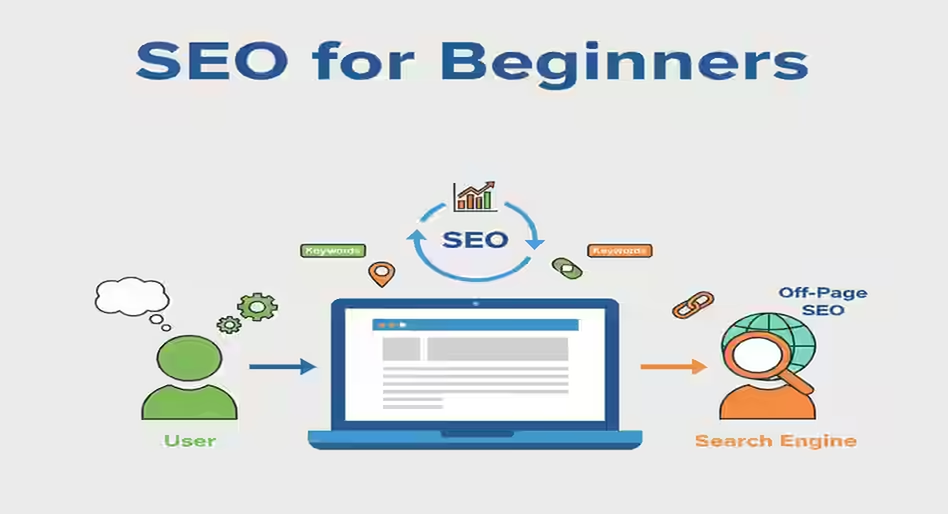
SEO for Beginners: A Simple Guide to Understanding Search Engines
If you are new to digital marketing, SEO can feel confusing, technical, and overwhelming. You hear words like keywords, rankings, indexing, and algorithms, but no one explains how they actually connect. This confusion is exactly why SEO for beginners often feels harder than it should be.
I know this feeling personally.
I started learning digital marketing during the pandemic. At first, I did not understand what the term “digital marketing” meant. I just remember feeling excited when I heard those words. There was energy in it. It sounded like the future. Without any clear direction, I jumped in the only way I knew how: by starting a blog.
My first website was called alltechsub, and it focused on digital electronics. I wrote articles, published content regularly, and kept the site running for almost two years. At that time, I was working hard, but I had no real understanding of SEO. I did not know how search engines worked, how keywords mattered, or why some pages ranked while others stayed invisible. I was doing “content,” but without strategy.
This is a common experience for anyone starting SEO for beginners without guidance. You put in effort, but results feel random. You publish posts, but traffic does not grow consistently. The problem is not motivation. The problem is missing fundamentals.
Over time, I realized that blogging alone was not enough. Understanding search engine optimization was the missing piece. That realization pushed me to stop the blog. I decided to focus on learning SEO properly. I also aimed to master WordPress web design. Once the basics of SEO started to make sense, everything I had struggled with earlier finally had answers.
This guide on SEO for beginners is written for people who are at that exact stage. Curious, motivated, but unsure where to start. We will break SEO down into simple concepts. We will explain how search engines actually work. We will show how different parts of SEO fit together.
Before tools, tactics, or trends, you need clarity. With a strong foundation, SEO stops feeling mysterious and starts feeling logical. This article aims to provide that clarity. It serves as a clear starting point for learning SEO for beginners the right way.
- SEO for Beginners: A Simple Guide to Understanding Search Engines
What Is SEO?
SEO stands for Search Engine Optimization. Simply put, it involves making your website easier for search engines to understand. It also makes it more helpful for people to use. The better your SEO, the more likely your pages will appear when someone searches for topics related to your website.
For beginners, SEO might sound complicated, but it really comes down to two goals:
- Helping search engines understand your content
- Helping users find what they need quickly and easily
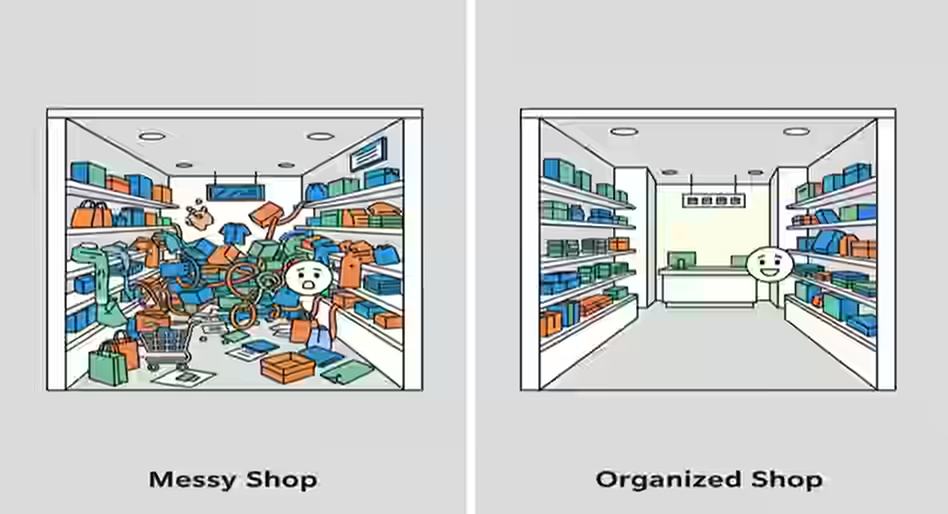
Think of it like running a store. If your shop is organized, easy to navigate, and clearly labeled, customers will find what they want and come back. If it’s messy and confusing, even the best products might go unnoticed. SEO works in the same way for your website.
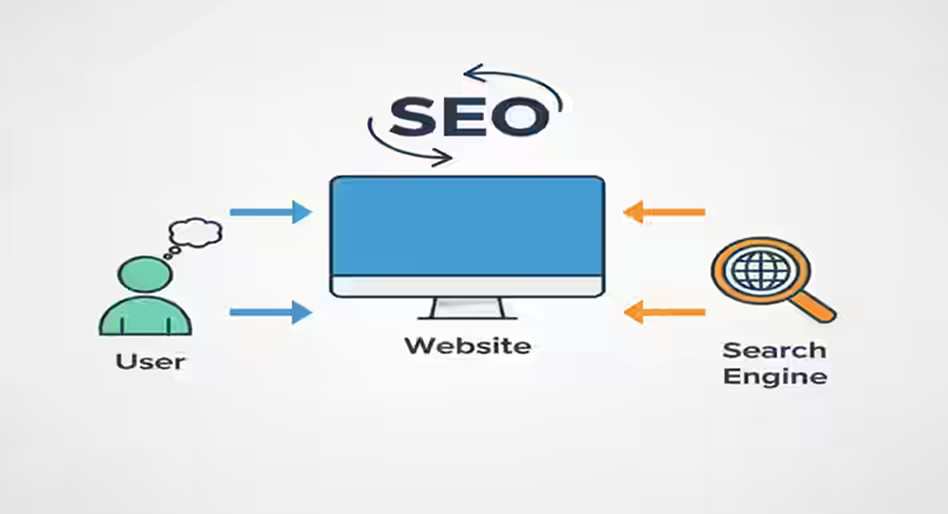
SEO in Real Life – A Simple Analogy
Imagine a giant library with millions of books. A person walks in and asks the librarian for a book on “digital electronics projects.” If the librarian knows where every book is stored, they can guide the person directly to it.
Search engines like Google act as that librarian. Your SEO efforts are like labeling and organizing your books correctly. This way, the librarian can find them quickly.
For beginners, this analogy makes it clear: if your site is structured well, has clear topics, and uses the right terms, search engines can connect it with people searching for the content you provide.
Why Beginners Struggle with SEO
Many beginners fail not because SEO is inherently difficult, but because it is misunderstood. Common reasons include:
- Focusing only on content without structure or optimization
- Ignoring how search engines read websites
- Using terms like “keywords” and “meta tags” without knowing how to implement them
This is exactly what I experienced with my first blog alltechsub. I published content I thought was valuable, but without SEO, the posts rarely reached readers outside my small circle. During those early years, I learned some important lessons. I realized that content creation alone is not enough. Understanding SEO is essential.
Internal Linking Strategy for Beginners
When learning SEO for beginners, it’s helpful to connect this foundational knowledge to more specific topics. Throughout this guide, you will see references to cluster articles like:
- Keyword Research for Beginners
- On-Page SEO Basics
- Technical SEO Explained Simply
- SEO Audit for Beginners
These links are not just for navigation—they tell search engines that your pillar article is the central authority on beginner SEO, while the cluster articles provide depth on each subtopic.
Summary of Key Points
- SEO = making your website understandable to both search engines and users
- Focus on helping users first, search engines second
- Beginners struggle because they overlook structure and fundamentals
- Real-life analogies (library, shop) help make SEO less intimidating
- Internal linking to cluster articles strengthens both user experience and SEO authority
How Search Engines Work (In Simple Terms)
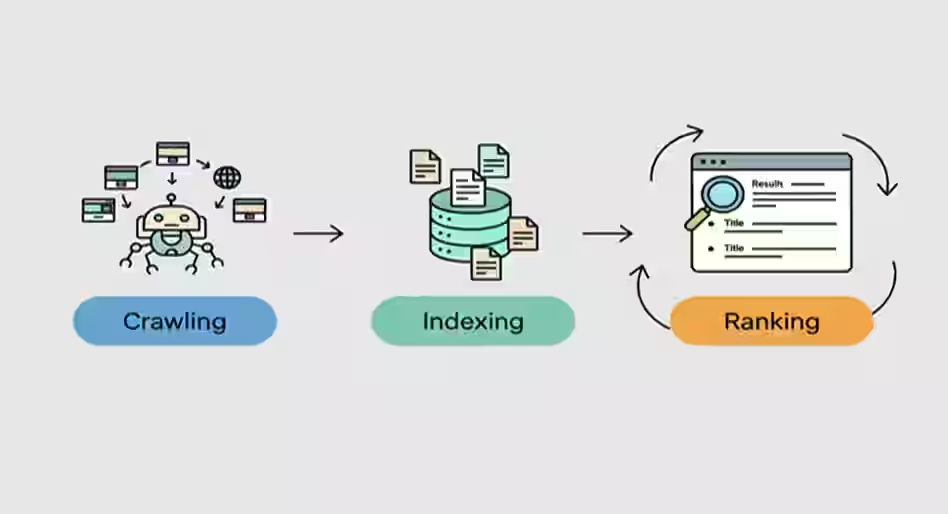
When learning SEO for beginners, understanding how search engines work is essential. Search engines like Google and Bing use complex systems. These systems are called crawlers or bots. They explore the internet and index pages. They also determine which pages are most relevant for a search query.
AI tools can generate content instantly. Despite this, search engines remain the primary way people find information online. AI tools can generate content quickly. However, search engines remain the main method people use to find information online. AI does not replace the need for SEO. In fact, AI-generated content still needs optimization to be found by users. Some experts even refer to this as AEO (Answer Engine Optimization). It involves optimizing content so AI and search engines can understand and surface it effectively.
Crawling, Indexing, and Ranking – Simplified
Here’s how search engines find and rank content in simple terms:
- Crawling – Search engine bots visit websites to read pages and follow links.
- Indexing – The content they find is stored in a massive database and analyzed for relevance and quality.
- Ranking – When a user searches, the search engine evaluates indexed pages and ranks them based on relevance, authority, and usability.
For beginners, think of it like this: crawling is the “scouting” stage. Indexing is the “filing” stage. Ranking is the “recommendation” stage. SEO for beginners is all about making sure your pages are easy to crawl, index, and rank.
SEO Is Evolving, but the Core Principles Remain
SEO is not static. SEO has come a long way from its early days when simple keyword stuffing could help you rank. Today, it involves sophisticated algorithms and AI-driven search. New concepts like AEO, Core Web Vitals, and semantic search reflect this evolution.
Despite changes, the core principles of SEO remain the same:
- Make your site understandable to search engines
- Provide real value to users
- Ensure content is relevant, accurate, and well-structured
Even as AI tools assist content creation or search engines evolve, these foundational rules never change. Learning SEO for beginners involves mastering the basics. This will serve as the foundation for adapting to future trends.
AI and SEO: The Relationship
- AI tools can generate content, but they cannot rank it for you automatically.
- AEO (Answer Engine Optimization) is an extension of SEO principles, focusing on structured, clear, and answer-focused content.
- Search engines still rely on traditional SEO factors like relevance, quality, backlinks, and user experience.
For beginners, this means AI is a tool, not a replacement. The better your SEO foundation, the more effectively AI can be leveraged to scale your content.
Summary of Key Points
- Search engines crawl, index, and rank content to deliver relevant answers.
- AI does not eliminate the need for SEO; it complements it.
- SEO has evolved over time, introducing concepts like AEO, but its core principles remain consistent.
- Beginners should focus on building a strong foundation—everything else is an extension.
Why SEO Matters for Beginners
If you’re just starting out, you might wonder: “Do I really need to learn SEO? Can’t I just post content and let AI or social media handle the traffic?”
Here’s the truth: without SEO, even the best content can go unnoticed. SEO is the bridge between your hard work and the people who need it. When I was learning back in the early days with my first blog, alltechsub, I saw this firsthand. I had content I was proud of, but because I didn’t understand SEO, very few people found it. That was frustrating—but it taught me an important lesson: content alone isn’t enough.
Organic Traffic vs Paid Traffic
Think of traffic like visitors to a shop:
- Paid traffic is like putting up flashy billboards and flyers. You get attention fast, but only while you pay.
- Organic traffic, which is driven by SEO, is like having a store in a prime location. People find you naturally, trust your expertise, and often come back.
For beginners, learning SEO means investing in the long-term growth of your website. Every optimization you do today can pay off months or even years later. That’s why mastering SEO for beginners is not just a skill—it’s an investment in visibility and credibility.
Trust and Credibility
Search engines don’t just rank content based on keywords. They want to show users reliable, useful, and high-quality information. If your website is well-structured, fast, mobile-friendly, and clear, users trust it—and search engines reward that trust with higher rankings.
For beginners, this might feel abstract. Here’s a simple test:
If you search for a topic and see two articles, one is messy and outdated. The other is clean, organized, and easy to read. You naturally click the second one. SEO ensures your site is that “second article” that people—and Google—choose.
Learning SEO Builds Confidence
Another reason SEO for beginners matters is confidence. When you understand how search engines work, the chaos of digital marketing suddenly makes sense. You also learn how to research keywords and structure content. You stop guessing and start making data-driven decisions.
Remember my journey? After running alltechsub for two years without much traction, I shifted focus to learning SEO and WordPress web design. That knowledge didn’t just help me rank websites; it gave me control over my digital presence. Instead of waiting for traffic, I could create it. That’s exactly what beginners should aim for.
Summary of Key Points
- SEO turns your hard work into visible results.
- Organic traffic is a long-term investment; paid traffic gives quick but temporary results.
- Search engines reward trust, credibility, and user-friendly websites.
- Learning SEO early builds confidence and gives beginners control over their digital presence.
Types of SEO Beginners Must Know
When starting with SEO for beginners, it helps to understand that SEO isn’t just one thing. It’s a combination of strategies that work together. Think of it like building a house: the foundation, walls, wiring, and decor all matter. Ignoring one part can weaken the whole structure.
There are four main types of SEO every beginner should know:
1. On-Page SEO
On-Page SEO includes all actions on your website to enhance its understanding. These actions make it valuable for both users and search engines.
Key elements include:
- Content quality – Writing useful, engaging, and relevant content.
- Keywords – Placing your main and related keywords naturally in titles, headings, and body text.
- Meta tags – Optimizing your meta title and description for clicks.
- Internal linking – Connecting pages on your site to help users and crawlers navigate.
- Images – Using descriptive file names, alt tags, and compressed images.
For beginners, On-Page SEO is where you see the fastest impact. If you want to dive deeper, check out our cluster article: On-Page SEO for Beginners.
2. Technical SEO
Technical SEO focuses on the behind-the-scenes parts of your site that affect crawling, indexing, and performance.
Important areas include:
- Site speed – Faster sites rank better and improve user experience.
- Mobile-friendliness – Google primarily uses mobile-first indexing.
- Sitemap and robots.txt – Helping crawlers understand which pages to index.
- Structured data – Helping search engines understand content with schema markup.
Even beginners benefit from understanding technical SEO, because it ensures your hard work on content isn’t wasted. For a full breakdown, see: Technical SEO Explained Simply.
3.Off-Page SEO
Off-Page SEO happens outside your website. It signals authority, trust, and popularity.
Key strategies include:
- Backlinks – Other websites linking to your content.
- Social signals – Engagement and mentions on social media platforms.
- Brand mentions – Even unlinked mentions help search engines see your authority.
For beginners, focusing on quality over quantity is important. Building a few strong, relevant links is better than chasing dozens of low-quality ones.
4. Local SEO
Local SEO is for businesses or blogs targeting a specific geographic area.
It includes:
- Google Business Profile optimization
- Local citations
- Reviews and reputation management
- Location-based keywords
If you’re just starting out and want to attract nearby users or clients, local SEO is essential. For a deeper dive, check out: Local SEO for Beginners.
Summary of Key Points
- SEO has multiple types: On-Page, Technical, Off-Page, and Local.
- On-Page SEO affects what users and search engines see directly.
- Technical SEO ensures your website functions properly for crawlers.
- Off-Page SEO builds authority and trust outside your site.
- Local SEO helps you attract users in a specific geographic area.
- Beginners should focus on understanding all four types while mastering the basics first.
SEO for Beginners Step-by-Step
Now that you understand the types of SEO, it’s time to see how everything comes together. For beginners, SEO can feel overwhelming, but breaking it down into steps makes it manageable. Think of it like cooking a meal: follow the recipe step by step, and you’ll get results. Skip steps, and it may not turn out as expected.
Here’s a simple roadmap for beginners to start implementing SEO effectively.
Step 1 – Keyword Research
Keywords are the foundation of SEO. They tell search engines what your content is about and help match your pages to the right searches.
For beginners:
- Start with tools like Google Keyword Planner, Ubersuggest, or even ChatGPT to discover terms your audience is searching for.
- Focus on long-tail keywords—they’re less competitive and more specific.
- Check search intent: are people looking for information, products, or services?
Think of this step as choosing the right topic for your blog or website page. Without it, your content is like a shop with no signboard.
Step 2 – Content Creation
Once you have keywords, create content that answers user questions clearly and thoroughly.
For beginners:
- Write in short paragraphs and use headings (H2, H3) to structure content.
- Use your target keyword naturally (aim for around 1–1.5% density).
- Include secondary keywords and related terms to cover the topic comprehensively.
- Add visuals, charts, or screenshots if they help explain your points.
High-quality content is the engine that drives SEO. Remember my first blog alltechsub—without understanding content structure, most of my posts didn’t reach people. Learning SEO helped me turn content into traffic.
Step 3 – On-Page Optimization
After creating content, optimize it so search engines understand it:
- Include the target keyword in the title, meta description, and headings.
- Add internal links to related pages or cluster articles.
- Optimize images with alt text and proper file names.
- Ensure your URLs are clear and descriptive.
This is where SEO for beginners starts showing real results. Even simple adjustments can improve rankings significantly.
Step 4 – Technical Checks
Before publishing, ensure your website is technically sound:
- Fast loading speed
- Mobile-friendly design
- Working links and proper site structure
- Robots.txt and sitemap configured
Technical issues can prevent search engines from crawling your content, no matter how good it is. For a deeper dive, see our cluster article: Technical SEO Explained Simply.
Step 5 – Monitor and Improve
SEO is not a one-time task. Once your content is live:
- Track rankings, clicks, and impressions using Google Search Console.
- Check analytics to see what content performs best.
- Adjust your strategy based on data.
Even beginners can start small: pick one post, track its performance, and learn from the results. Over time, these small improvements compound into significant growth.
Summary of Key Points
- Start with keyword research to find what your audience is searching for.
- Create high-quality, structured content around your keywords.
- Optimize content with on-page SEO elements.
- Ensure your website is technically sound.
- Monitor performance and continuously improve.
Common SEO Mistakes Beginners Make
Even with the best intentions, beginners often make mistakes that slow down progress or prevent results. Understanding these early can save you months of frustration. Think of this as learning from my mistakes so you don’t have to repeat them.
Mistake 1 – Keyword Stuffing
Many beginners think using the keyword everywhere will boost rankings. It doesn’t.
- Overusing keywords makes your content unnatural and hard to read.
- Search engines can detect keyword stuffing and may penalize your site.
- Solution: Use your main keyword naturally (~1–1.5% density) and include related terms to cover the topic comprehensively.
Remember, quality matters more than quantity. SEO for beginners is about relevance, not repetition.
Mistake 2 – Ignoring Search Intent
Another common error is creating content without understanding why people are searching.
- Example: Writing a detailed product guide when users are looking for a quick comparison.
- If your content doesn’t match what users want, they leave quickly, and search engines notice.
- Solution: Always check the top results for your target keyword and identify the search intent—informational, transactional, navigational, or local.
Aligning content with search intent is a core principle of SEO for beginners that many skip.
Mistake 3 – Skipping Technical Basics
Beginners often focus only on writing content and ignore technical SEO:
- Broken links, slow pages, or missing meta tags can prevent ranking.
- Mobile-unfriendly sites lose a large portion of traffic.
- Solution: Learn basic technical checks—speed, mobile optimization, sitemap, robots.txt, and structured data.
Even a well-written blog post will struggle to rank without these foundational steps.
Mistake 4 – Neglecting Internal Linking
Internal links guide users and search engines through your site. Many beginners forget this step:
- Result: Important pages remain “hidden” from search engines.
- Solution: Link to related posts and cluster articles naturally, using descriptive anchor text.
Think of internal linking as giving search engines a map of your website, which is essential for visibility.
Mistake 5 – Expecting Instant Results
SEO is a long-term strategy. Beginners often expect instant traffic:
- Ranking takes time, even with perfect optimization.
- Impatience leads to abandoning strategies or chasing shortcuts.
- Solution: Set realistic expectations and track progress using tools like Google Search Console and analytics.
Patience is a skill in SEO. SEO for beginners requires consistent effort, not instant gratification.
Summary of Key Points
- Avoid keyword stuffing; focus on natural usage and related terms.
- Understand search intent before creating content.
- Don’t ignore technical SEO; foundations matter.
- Use internal linking to guide both users and search engines.
- SEO is long-term; results take time, consistency, and patience.
How Long Does SEO Take for Beginners?
One of the first questions I get from beginners is: “If I do everything right, how long until I see results?” The honest answer is—it depends. SEO is not instant, but with consistent effort, beginners can see progress faster than they expect.
Early Results (1–3 Months)
- You may start seeing impressions and clicks in Google Search Console.
- Some low-competition keywords might rank on the first page.
- Early wins are mostly about fixing technical issues, optimizing existing content, and internal linking.
Medium-Term Growth (3–6 Months)
- Rankings improve for more competitive keywords.
- Organic traffic begins to grow steadily.
- You start understanding what content and strategies work best.
During this stage, consistency is key. Regular content updates, ongoing keyword research, and monitoring results will compound your gains.
Long-Term Impact (6–12 Months and Beyond)
- Your website begins to rank for multiple keywords across different topics.
- Authority and trust with both users and search engines increase.
- SEO becomes easier to maintain as your site grows.
Remember: even with AI tools or advanced strategies, the core principle of SEO for beginners remains the same. Help users find value. Make it easy for search engines to understand your content. Long-term results are always the outcome of solid fundamentals.
These timelines help beginners understand how SEO progresses in theory. In real business scenarios, results often take longer, especially for small businesses competing with established websites and platforms. We explain this gap in detail in our guide. It covers why SEO takes longer for small businesses. The guide also shows what realistic progress looks like beyond beginner-level expectations.
Key Takeaways
- SEO is a long-term strategy, not a quick fix.
- Beginners can see initial results within 1–3 months, but substantial growth usually takes 6–12 months.
- Consistency, monitoring, and improvement compound over time.
- Solid SEO foundations make future growth easier, regardless of evolving algorithms or AI trends.
Final Thoughts + Learning Path
Learning SEO for beginners can feel overwhelming at first, but it doesn’t have to be. Think of it like learning a new language: you start with the basics, practice consistently, and gradually become fluent. The key is understanding the fundamentals and building on them step by step.
Remember my journey with alltechsub. I started with curiosity, no real knowledge, and lots of trial and error. Two years later, after focusing on SEO and WordPress web design, I finally had control over my website’s visibility. That’s exactly what every beginner can achieve with the right approach.
Your Learning Path as a Beginner
Here’s a simple roadmap to keep you on track:
- Master the Basics – Understand SEO principles, how search engines work, and why they matter.
- Keyword Research – Learn to find terms your audience searches for. (See: Keyword Research for Beginners)
- Content Creation & On-Page SEO – Write structured, high-quality content and optimize it for keywords. (See: On-Page SEO for Beginners)
- Technical SEO – Make sure your website is crawlable, fast, and mobile-friendly. (See: Technical SEO Explained Simply)
- Monitor, Improve, Repeat – Use analytics and Search Console to track results and make adjustments.
By following this path, beginners can gradually move from confusion to confidence, turning SEO into a skill that drives real results.
SEO Is a Journey, Not a Destination
SEO is always evolving. Algorithms change, AI tools emerge, and new optimization strategies appear. But the core principle of SEO for beginners never changes: make your website understandable to search engines and valuable to users. Focus on that, and everything else becomes easier.
Frequently Asked Questions About SEO for Beginners

Tenzin Tashi is an SEO and WordPress FSE web design specialist at Tenz Digital. He focuses on on-page and technical SEO, keyword research, and building SEO-friendly websites using modern analytics tools.