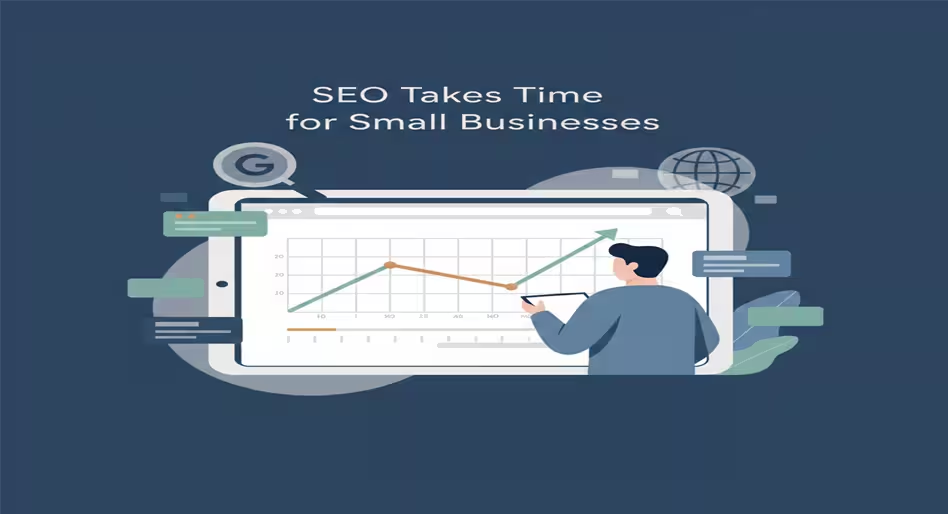
Why SEO Takes Longer for Most Small Businesses
Why SEO takes longer for small businesses often becomes clear only after they start SEO based on a familiar promise: results in three to six months. Agencies talk about rankings improving, traffic growing, and sometimes even leads coming in. The timeline sounds reasonable and low risk, so moving forward feels safe
Months later, the work may be happening, but the business does not feel the impact. Leads are flat. Revenue looks the same. At this point, most business owners land on one of two conclusions. Either SEO does not work, or the agency failed to deliver.
In reality, SEO is often working exactly as it should. What failed was the expectation.
Small businesses are frequently sold generic timelines that ignore where they are actually starting from. They are compared, directly or indirectly, to websites with years of authority, deeper content, stronger backlinks, and larger budgets. This article explains why SEO genuinely takes longer for small businesses. It also describes why that delay is normal and what a realistic path forward looks like in 2026.
If you’re new to SEO, you should understand the fundamentals first. Before thinking about timelines and results, start with our SEO for beginners guide.
- Why SEO Takes Longer for Most Small Businesses
- The SEO Timeline Most Agencies Sell
- Why Small Businesses Are Not Starting on Equal Ground
- Authority Builds Slowly and Can not Be Rushed
- Competition Is Tougher Than It First Appears
- SEO Work Happens Before Results Are Visible
- Website and Technical Issues Often Delay Everything
- Content Moves Slower for Small Businesses
- Content Moves Slower for Small Businesses
- What a Realistic SEO Timeline Looks Like for a Small Business in 2026
- How to Tell Slow but Healthy SEO from Bad SEO
- Why Honest Timelines Protect Small Businesses
- Final Thoughts: SEO Is Not Slow, It Is Accumulative
- Frequently Asked Questions
The SEO Timeline Most Agencies Sell
The most common SEO promise is some version of “results in three to six months.” It sounds professional, fits neatly into sales conversations, and feels achievable without being reckless.
What is rarely explained is what the word results actually means.
For agencies, results often refer to internal SEO signals. These include pages getting indexed, impressions rising in Search Console, or early keyword movement. For small business owners, results usually mean phone calls, enquiries, bookings, or sales.
When one word is used to describe two very different outcomes, disappointment becomes almost inevitable.
These timelines are not always dishonest. They are averages that work in certain scenarios, especially for websites that already have some authority or face weak competition. Agencies reuse them because they simplify decision-making and help close deals. Small businesses rarely hear the full context: SEO timelines depend heavily on starting conditions, not just effort.
Why Small Businesses Are Not Starting on Equal Ground
Search engines prioritize trust, history, and consistency. This is where most small businesses begin at a disadvantage.
Many small business websites are new, recently redesigned, or lightly maintained. They have limited indexed pages, thin topical coverage, and few strong external signals. At the same time, they face competition from directories, large platforms, and franchises. They also compete with lead-generation sites that have been building authority for years.
Budget also affects timelines, but not simply in terms of spend. Smaller budgets slow execution. Content is published carefully. Technical fixes are phased. Outreach is selective. This is why well-structured affordable SEO services focus on steady, compounding progress rather than aggressive tactics that rarely hold.
This does not mean SEO will fail for small businesses. It means progress happens in layers rather than leaps. Sustainable growth replaces quick wins.
Authority Builds Slowly and Can not Be Rushed
Stable SEO performance is driven by authority. Authority is not a single metric or shortcut. It is the combined result of relevant content, trusted links, consistent signals, and time.
Small businesses usually lack authority not because they are untrustworthy, but because they are unknown to search engines. New signals are tested cautiously. Rankings may fluctuate before stabilizing. Early progress often looks inconsistent.
This phase can feel uncomfortable, especially when expectations were set too high. But volatility early on is normal for low-authority sites. Authority compounds slowly, and once it reaches a certain threshold, results become more predictable.
Shortcuts that attempt to accelerate authority usually create instability or long-term damage. That is why realistic SEO takes longer but lasts longer.
Competition Is Tougher Than It First Appears
SEO competition is often underestimated because tools simplify it into scores. Real competition is about who already owns the search results and how entrenched they are.
For small businesses, competitors are rarely just other small businesses. They are often directories, marketplaces, national brands, or platforms that dominate organic results and local listings. These sites may not look impressive, but they carry years of trust and backlinks.
In local search, competition becomes even denser. A single city can have dozens of similar service providers plus multiple platforms competing for visibility. Outranking them requires closing trust gaps over time, not just optimizing pages.
When competition is misjudged, timelines shrink on paper and stretch painfully in reality.
SEO Work Happens Before Results Are Visible
One of the hardest truths about SEO is that the work always comes before the outcome.
Early months are spent fixing technical issues, improving site structure, aligning pages with intent, and building a solid foundation. These changes matter, but they do not create instant traffic or leads.
Search engines also need time to crawl, index, and reassess changes. Smaller sites are crawled less frequently, which extends the delay between action and impact.
This is why SEO can feel slow even when progress is being made. Without clear explanation, patience wears thin and trust erodes.
Website and Technical Issues Often Delay Everything
Many small business websites look fine on the surface but struggle underneath. Common issues include thin service pages, unclear location targeting, slow performance, poor mobile experience, and confusing navigation.
SEO cannot scale until these problems are addressed. Fixing foundations takes time, especially when changes affect structure, content, and user experience.
Skipping this phase may produce short-term movement, but those gains rarely hold. Sustainable SEO requires a site that search engines and users can both trust.
Content Moves Slower for Small Businesses
Content is a long-term growth driver, but small businesses cannot publish at the same pace as larger organisations.
Content creation competes with daily operations, sales, and cash flow. Publishing fewer pages means authority grows more slowly, even when quality is high.
This is not a weakness. It is a constraint that must be planned for. Slow, intentional content still works. It simply stretches timelines.
Problems arise when slow execution is paired with aggressive promises.
Content Moves Slower for Small Businesses
Content is a long-term growth driver, but small businesses cannot publish at the same pace as larger organisations.
Content creation competes with daily operations, sales, and cash flow. Publishing fewer pages means authority grows more slowly, even when quality is high.
This is not a weakness. It is a constraint that must be planned for. Slow, intentional content still works. It simply stretches timelines.
Problems arise when slow execution is paired with aggressive promises.
What a Realistic SEO Timeline Looks Like for a Small Business in 2026
A realistic SEO timeline focuses on progression, not instant outcomes.
Months 1–3:
Foundation phase. Technical fixes, site structure improvements, initial content, Google Business Profile optimization, and basic citations. Early signals appear such as better indexing and rising impressions. Traffic and leads are usually flat, which is normal.
Months 4–6 (sometimes 8):
Early traction. Some pages begin ranking for lower-competition terms. Fluctuations are common as search engines test trust. Modest traffic growth may begin. In favorable niches, the first consistent leads may appear.
Months 9–12 and beyond:
Compounding phase. Rankings stabilize, click-through rates (CTR) improve, and more pages contribute to traffic. Leads become more predictable. This is where SEO starts to meaningfully impact revenue.
SEO growth is rarely linear. It compounds.
How to Tell Slow but Healthy SEO from Bad SEO
Slow SEO is not automatically bad SEO. The difference lies in clarity. Healthy SEO is structured and transparent. You understand what is being done, why it matters, and how progress is being measured beyond rankings.
Bad SEO feels vague. Activities are listed without context. Timelines keep shifting without explanation. There is no clear connection between work and outcomes. Small businesses should accept patience. They should not accept confusion.
Why Honest Timelines Protect Small Businesses
Unrealistic promises create pressure to chase shortcuts. Honest timelines protect budgets, expectations, and long-term results.
When expectations are realistic, SEO becomes easier to evaluate and far less frustrating. Progress feels slower, but it is also safer and more predictable.
That is the core of well-structured affordable SEO: steady, compounding growth instead of fragile wins.
Final Thoughts: SEO Is Not Slow, It Is Accumulative
SEO feels slow when it is sold as fast. In reality, it rewards relevance, trust, and consistency over time.
Small businesses do not fail at SEO because they move slowly. They fail when expectations are misaligned with reality.
With honest timelines and the right strategy, SEO becomes predictable, sustainable, and genuinely profitable.
Frequently Asked Questions

Tenzin Tashi is an SEO and WordPress FSE web design specialist at Tenz Digital. He focuses on on-page and technical SEO, keyword research, and building SEO-friendly websites using modern analytics tools.