What Realistic SEO Progress Looks Like for a Small Business Website
One of the hardest parts of SEO for business owners is understanding realistic SEO progress for small businesses. Owners often struggle to know whether the work being done is actually moving things forward. Traffic may stay flat. Leads may feel inconsistent. Rankings can move up and down. These fluctuations often create doubt even when the strategy itself is sound.
It is knowing whether that work is actually making a difference.
Most business owners can accept that SEO takes time. What they struggle with is the uncertainty in between. Traffic does not suddenly jump. Leads do not arrive on a fixed date. Rankings seem to move one week and stall the next. This creates doubt, even when the work itself is sound.
That doubt usually leads to the wrong question. “Is SEO working?” A more useful question is this:
Does this progress look healthy for where my business is right now?
This article is written to help answer that question. We won’t give promises or timelines. Instead, we’ll explain how realistic SEO progress shows up for a small business website. This is especially true before it turns into obvious results.
SEO Progress Is Rarely Obvious at First
SEO does not behave like paid advertising. There is no switch you flip where results suddenly turn on.
With ads, you launch a campaign and something happens immediately. With SEO, the work goes out first and the response comes back later, often in small and uneven ways.
For small businesses, this is uncomfortable. You may be publishing content, fixing technical issues, or restructuring pages, yet nothing feels different from the outside. The site looks the same. Enquiries feel unchanged. That gap between effort and visible outcome is where most frustration begins.
This frustration makes more sense once you understand why SEO takes longer for most small businesses. Those delays are usually structural. They are not a sign that something is broken.
What helps is understanding that SEO progress almost always shows up as signals before it shows up as sales. Those signals are easy to miss if you do not know what you are looking for.
The Difference Between SEO Activity and SEO Progress
This distinction matters more than most people realize. SEO activity is the work being done. SEO progress is what changes as a result of that work.
Activity looks like:
- Publishing or updating content
- Fixing technical problems
- Improving internal linking or site structure
Progress looks like:
- Pages being indexed more consistently
- Search queries becoming more relevant to your services
- Visibility increasing around the topics you actually want to be known for
Many businesses confuse effort with outcomes. When progress is judged only against cost, this confusion becomes even stronger. That is why we explain this difference clearly. Our guide on affordable SEO for small businesses addresses this issue. In small businesses, expectations are often misaligned from the start.
You can be doing the right activities and still not see progress immediately. That does not automatically mean something is wrong.
An affordable SEO approach should be evaluated by clarity and progress signals. It should not be judged by how quickly it promises visible wins.
Early SEO Signals That Matter (Even When Traffic Is Low)
In the early stages of SEO, traffic is usually the weakest indicator. A more realistic way to judge progress is to look at how search engines are starting to understand your site.
Healthy early signals often include:
- Your pages appearing for more relevant search queries
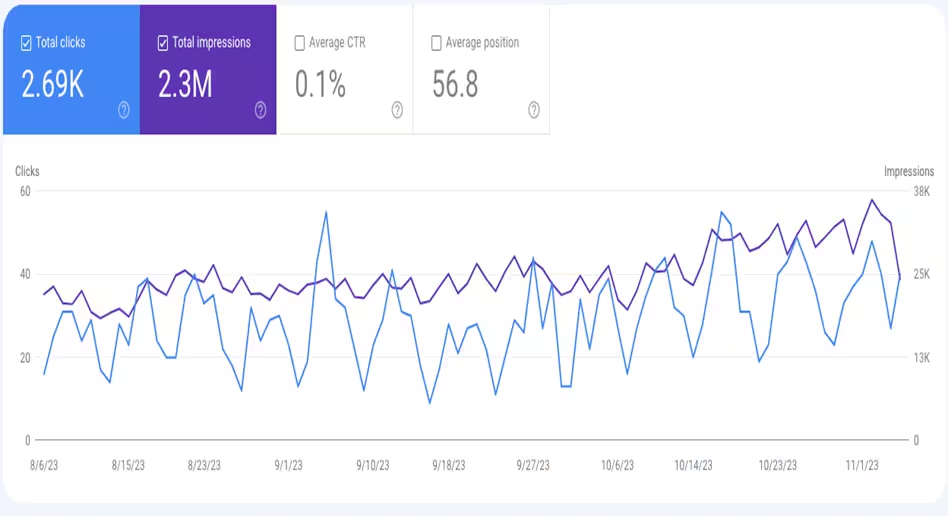
- Impressions trending upward over time, even if slowly
- Fewer unrelated or low-quality keywords showing in Search Console (GSC)
- Important pages being crawled more frequently
These changes suggest that your site is being categorized more accurately. Search engines are testing where you belong. That process takes time, especially for smaller or newer sites.
At this stage, it is common for leads to remain flat. That does not mean progress is not happening. It means the foundation is still being laid.
Mid-Stage SEO Signals That Indicate Momentum
As SEO matures, progress becomes easier to recognize. This is usually the phase where movement starts to feel less random and more directional. Rankings may still fluctuate, but they do so within a narrower range. Pages start appearing for multiple variations of the same topic instead of single keywords.
Typical mid-stage signals include:
- Rankings stabilizing instead of jumping up and down daily
- Individual pages ranking for several related queries
- Click-through rates (CTR) improving before traffic noticeably increases
- Older pages lifting when new content is published
This is often the point where business owners start reassessing whether their SEO setup makes sense. Momentum here depends less on effort. It relies more on structure and prioritization. This is why understanding SEO packages for small businesses becomes relevant at this stage.
Good structure amplifies progress. Poor structure slows it, even when work continues.
Late-Stage SEO Signals That Show Compounding Growth
When SEO is working well over time, progress begins to stack instead of reset.
You may notice things like:
- New pages ranking faster than earlier ones did
- Fewer technical issues appearing over time
- Organic leads becoming more consistent rather than sporadic
- Less need for constant tweaking to maintain visibility
SEO starts to feel more predictable. Not exciting, but dependable. That predictability is the result of accumulated trust, not sudden breakthroughs. This is where SEO shifts from feeling experimental to feeling like a real business asset.
What Bad SEO Looks Like, Even When Reports Look Good
Not all movement is healthy movement. Some warning signs only become clear when you look beyond surface metrics.
Unhealthy SEO often looks like:
- Rankings improving for keywords that do not match your services
- Traffic increasing without any change in enquiries or calls
- Reports listing actions without explaining impact
- Strategy changing frequently with no clear reasoning
Good SEO may feel slower, but it feels understandable. Bad SEO often feels busy and confusing at the same time. Clarity is usually a better indicator of quality than speed.
Why Real SEO Progress Feels Quiet, Not Exciting
One of the most surprising things about effective SEO is how uneventful it feels.
There are no dramatic spikes or overnight wins. Instead, progress shows up in three ways. You experience fewer problems. You gain steadier visibility. You have better conversations with prospects who already have some trust before they contact you.
This is why genuinely affordable SEO services focus on sustainability rather than speed. The goal is not to impress quickly, but to build something that holds under pressure.
Quiet progress is usually the most reliable kind.
Final Thoughts: Learning to Read SEO Progress Changes Everything
Small businesses do not need SEO to be fast. They need it to be understandable.
When progress is interpreted correctly, SEO becomes less stressful and easier to evaluate. Confidence replaces guesswork. Decisions are made based on signals rather than promises.
That shift alone often makes SEO more effective, because patience is no longer forced. It makes sense. That is what realistic SEO progress actually looks like.