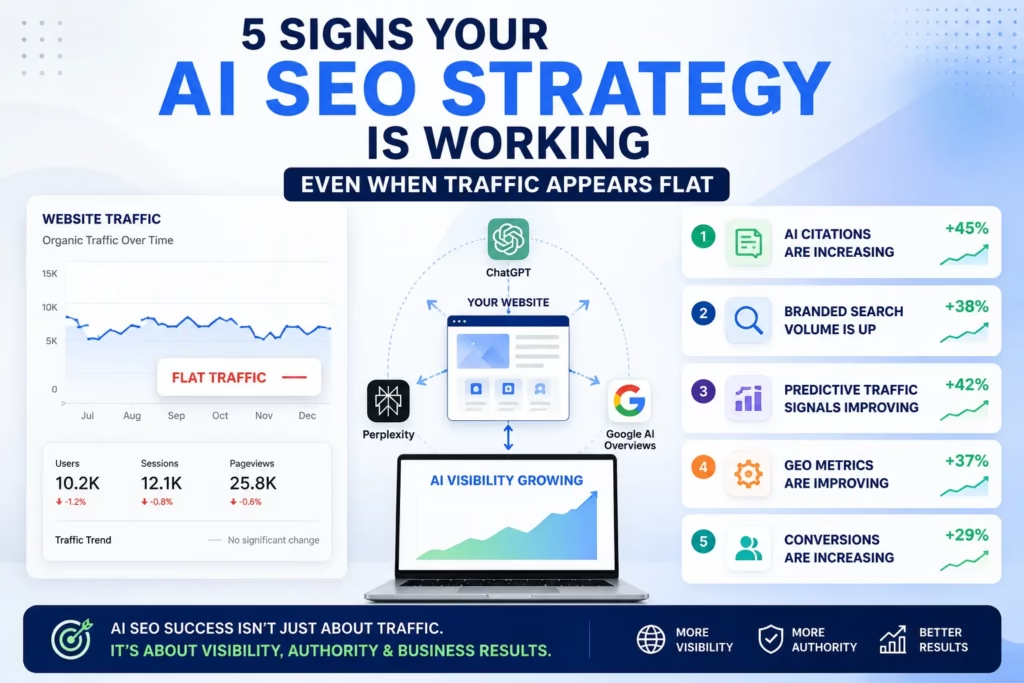
5 Signs Your AI SEO Strategy Is Working Even When Traffic Appears Flat
For years, SEO professionals relied on three core metrics to measure success: rankings, organic traffic, and clicks. If those numbers increased, the strategy was working. If they declined, something needed to be fixed.
In 2026, that approach is becoming outdated. The rise of AI-powered search experiences has fundamentally changed how users discover information online. Many people now receive answers directly from AI tools without ever clicking a website link. As a result, businesses may see flat or declining traffic while their visibility, authority, and revenue continue to grow.
This shift requires marketers to rethink how SEO performance is measured. Instead of focusing only on clicks and rankings, businesses must monitor AI citations, branded search growth, predictive traffic signals, GEO metrics, and conversion improvements. These indicators often reveal success long before traditional SEO reports do.
If you’re new to the concept, start with our guide on What Is AI SEO? before exploring the performance signals discussed below.
Let’s explore the five signs that show your AI SEO strategy is gaining momentum.
Table of Contents
What Is AI SEO?
AI SEO is the practice of optimizing content and websites to improve visibility within AI-powered search experiences. It focuses on helping content become discoverable, understandable, and reference-worthy for both traditional search engines and AI systems that generate answers for users.
The Rise of Zero-Click AI Search
For more than two decades, SEO success followed a relatively simple formula. A user entered a query into a search engine, reviewed the results, clicked on a website, and completed an action such as reading an article, requesting a quote, or making a purchase.
That process is changing rapidly.
In 2026, millions of users are finding answers through AI-powered search experiences that often eliminate the need to visit a website. Platforms such as ChatGPT, Perplexity, and Google’s AI-generated search results can provide detailed responses directly within the search interface. Users receive the information they need without clicking through to a source.
This shift has created a new challenge for marketers and business owners. Traditional SEO reports may show flat or declining organic traffic, even when a brand’s visibility and influence are growing across AI search platforms.
If you’re wondering why some content earns citations while other content is ignored, our What Is GEO? guide explains how Generative Engine Optimization influences source selection within AI-generated answers.
What Is Zero-Click Search?
A zero-click search occurs when a user receives the answer to their question directly within the search results or an AI-generated response without visiting another website.
For example, a user might ask:
- What are the most important AI SEO metrics in 2026?
- How can I increase AI citations for my website?
- What is Generative Engine Optimization (GEO)?
Instead of clicking multiple search results, the user may receive a complete answer generated by an AI platform. The answer often includes information gathered from several trusted sources.
In this scenario, your content may contribute to the answer even if the user never visits your website.
Why Traditional Traffic Metrics Are Becoming Less Reliable
Many businesses still evaluate SEO performance primarily through:
- Organic sessions
- Click-through rates
- Keyword rankings
- Traffic growth
While these metrics remain important, they no longer provide the full picture.
Consider two websites:
Website A receives 10,000 monthly visitors but rarely appears in AI-generated answers.
Website B receives 8,000 monthly visitors but is frequently cited by AI systems and generates a growing number of branded searches and qualified leads.
Traditional analytics would suggest Website A is performing better. However, Website B may actually have stronger long-term growth potential because it is building visibility where users are increasingly searching for information.
This is why modern SEO strategies must look beyond traffic alone.
The New Customer Journey
AI search is creating a different path to conversion. In the traditional search journey, the process often looked like this:
Search Query → Website Click → Research → Conversion
Today, the journey may look more like this:
AI Query → AI Answer → Brand Discovery → Branded Search → Conversion
A user might discover your company through an AI-generated recommendation and then search directly for your brand name later. Because the initial interaction occurred within an AI platform, standard analytics tools may never attribute that discovery correctly.
As a result, many businesses underestimate the impact AI search is already having on their marketing performance.
Why AI Visibility Matters More Than Ever
Being visible within AI-generated answers offers several advantages:
- Increased brand awareness
- Higher trust and credibility
- More qualified traffic
- Stronger purchase intent
- Greater long-term authority
Users often perceive sources mentioned by AI systems as trusted recommendations. When your content consistently appears in AI-generated responses, your brand gains exposure at a critical stage of the decision-making process.
This is one reason many marketers are beginning to track AI citations, answer inclusion rates, and branded search growth alongside traditional SEO metrics.
The Future of SEO Is Visibility Across Multiple Search Experiences
SEO is no longer limited to ranking on the first page of Google. Modern search visibility includes:
- Traditional search engine rankings
- AI-generated search results
- AI citations and mentions
- Brand discovery through AI platforms
- Voice search visibility
- Knowledge panel and entity recognition
Businesses that adapt to this evolving search landscape will be better positioned to attract customers regardless of how search technology continues to change.
The most successful SEO strategies in 2026 focus not only on earning clicks but also on becoming a trusted source that AI systems choose to reference, summarize, and recommend.
How AI Search Engines Choose Sources
One of the biggest misconceptions in modern SEO is that AI search engines simply pull information from the highest-ranking Google results.
In reality, AI systems use a much more sophisticated process when deciding which sources to reference. A page can rank outside Google’s top 10 results and still be cited by AI platforms if it provides the most useful, complete, and trustworthy answer to a specific question.
Understanding how AI systems evaluate content can help businesses create resources that are more likely to be surfaced in AI-generated responses.
AI Systems Prioritize Answer Quality Over Ranking Position
Traditional search engines are designed to return a list of webpages that users can explore themselves. AI search engines have a different goal. They must generate a direct answer.
To accomplish this, they analyze content from multiple sources and identify information that best addresses the user’s question.
For example, if someone asks:
“What are the most important AI SEO metrics to track in 2026?”
An AI system may combine information from industry studies, expert opinions, case studies, and educational resources before generating a response.
In this situation, the most useful source may not always be the page with the highest ranking. Instead, it is often the page that provides the clearest and most complete explanation.
Comprehensive Coverage Increases Citation Potential
AI systems prefer content that covers a topic thoroughly rather than touching on it briefly.
Compare these two articles:
Article A
- Defines AI SEO
- Contains 800 words
- Covers one or two examples
Article B
- Defines AI SEO
- Explains AI citations
- Discusses GEO metrics
- Includes examples
- Provides implementation steps
- Answers common questions
When AI systems evaluate both pages, the second article offers significantly more context and supporting information.
As a result, comprehensive content is often more likely to contribute to AI-generated answers.
Characteristics of Highly Citable Content
| More Likely to Be Cited | Less Likely to Be Cited |
|---|---|
| Comprehensive coverage | Thin content |
| Clear structure | Disorganized information |
| Original examples | Generic advice |
| Updated information | Outdated content |
| Topic depth | Surface-level explanations |
| User-focused answers | Keyword-focused content |
| Practical guidance | Vague recommendations |
Clear Structure Helps AI Understand Content
The way information is organized can influence how easily AI systems interpret a page.
Content becomes easier to process when it includes:
- Descriptive headings
- Short paragraphs
- Bullet points
- Numbered steps
- Question-and-answer sections
- Summary sections
A well-structured article helps AI models quickly identify the most relevant information for a specific query.
For example, a section titled “How to Track AI Citations” provides a clearer signal than a generic heading such as “Important Information.”
Consistency Across Related Topics Builds Trust
AI systems evaluate more than a single article.
They often assess whether a website demonstrates expertise across an entire subject area.
For example, a website publishing content about:
- AI SEO strategy
- Generative Engine Optimization
- Technical SEO
- Content optimization
- Search analytics
may be viewed as a stronger source than a website with only one article on AI SEO.
This is why building topic clusters can improve visibility across both traditional and AI-driven search experiences.
Original Examples Help Differentiate Content
Many websites repeat the same advice.
AI systems encounter thousands of articles that discuss similar concepts using nearly identical wording.
Original examples help a page stand out.
For instance, instead of simply stating that branded searches can increase because of AI visibility, an article could illustrate the process:
A user asks an AI assistant for the best SEO agencies for startups. The AI mentions a company as a potential option. Later, the user searches for that agency by name to learn more about its services.
Examples like this help explain concepts more clearly while providing unique value that generic content often lacks.
The Best AI-Friendly Content Solves a Specific Problem
The most citable content is often created with a clear user problem in mind.
Rather than writing broadly about SEO, successful content focuses on answering specific questions such as:
- Why is my organic traffic declining?
- How can I improve AI visibility?
- What are AI citations?
- How do I measure GEO performance?
When a page solves a specific problem better than competing content, it becomes more useful for both users and AI systems.
Focus on Becoming the Best Answer
Many SEO strategies still revolve around rankings alone.
However, AI search is shifting the focus from ranking for a keyword to becoming the best answer for a topic.
Businesses that create detailed, structured, and genuinely helpful content are more likely to be referenced by AI systems regardless of their exact ranking position.
As AI search continues to evolve, the websites that consistently answer users’ questions better than anyone else will have the greatest opportunity to earn visibility, citations, and long-term authority.
What Is AI Visibility?
AI visibility refers to how often a brand, website, or piece of content appears within AI-generated answers, recommendations, summaries, and citations. Strong AI visibility increases brand awareness even when users do not directly click through to a website.
Common Mistakes Businesses Make When Measuring AI SEO
As AI search becomes a larger part of how people discover information online, many businesses are struggling to evaluate their SEO performance accurately.
The problem is not always poor results. In many cases, companies are still using measurement frameworks that were designed for a search landscape that no longer exists. As a result, they may overlook early signs of growth and make unnecessary changes to strategies that are actually working.
Here are some of the most common mistakes businesses make when measuring AI SEO performance.
Mistake #1: Treating Traffic as the Only Success Metric
For years, organic traffic has been one of the most important indicators of SEO success.
While traffic remains valuable, relying on it as the sole performance metric can create a misleading picture of reality.
A website may be:
- Frequently cited in AI-generated answers
- Mentioned by AI assistants during product recommendations
- Discovered through conversational search experiences
Yet none of these interactions may generate an immediate website visit.
Businesses that focus exclusively on traffic risk missing important visibility gains that could influence future purchasing decisions.
Mistake #2: Ignoring Branded Search Growth
Many organizations pay close attention to non-branded keywords while overlooking changes in branded search demand.
This can be a costly mistake.
When users encounter a brand through AI-generated recommendations, they often conduct a separate branded search later to learn more about the company.
Examples include searches such as:
- Tenz Digital
- Tenz Digital reviews
- Tenz Digital SEO services
- FusionSEO pricing
An increase in branded searches can indicate growing awareness and trust, even if overall traffic remains stable.
For this reason, branded search trends should be monitored alongside traditional SEO metrics.
Mistake #3: Focusing Only on Rankings
Keyword rankings still matter, but they are no longer the complete story. A page ranking in the third or fourth position may still contribute to AI-generated answers if it provides valuable information.
Likewise, a page holding a top ranking may not be referenced by AI systems if it lacks depth or fails to address the user’s intent effectively.
Businesses should evaluate rankings as one signal among many rather than treating them as the ultimate measure of success.
Mistake #4: Overlooking Content Performance Beyond Clicks
Many content teams evaluate articles primarily through pageviews.
However, content can provide value in ways that are not always visible through traditional analytics platforms.
A well-researched article may:
- Build authority on a topic
- Support AI-generated answers
- Increase brand recognition
- Influence future conversions
- Strengthen topical relevance across a website
This broader impact often develops over time and may not be reflected immediately in traffic reports.
Mistake #5: Failing to Refresh Existing Content
Some businesses focus heavily on publishing new content while neglecting articles that are already performing well. Outdated information can reduce a page’s usefulness over time. Regular updates help ensure that content remains accurate, relevant, and competitive.
Content refreshes may include:
- Updating statistics
- Adding recent examples
- Expanding sections
- Improving internal links
- Addressing emerging trends
In many cases, improving an existing article can deliver better results than creating a new one from scratch.
Mistake #6: Measuring Visibility Without Measuring Business Outcomes
SEO ultimately exists to support business growth. A website can experience increases in rankings and traffic without generating meaningful results. At the same time, another website may receive fewer visitors but produce more leads, inquiries, and revenue.
This is why businesses should monitor metrics such as:
- Lead generation
- Contact form submissions
- Consultation requests
- Sales inquiries
- Conversion rates
These indicators often provide a clearer picture of SEO performance than traffic alone.
Mistake #7: Expecting Immediate Results From AI SEO
AI visibility is not built overnight. Establishing authority across a topic requires consistent effort over time. Businesses often publish a few articles, fail to see immediate results, and conclude that the strategy is ineffective.
In reality, AI SEO works much like traditional SEO. Results often compound gradually as content depth, topical coverage, and brand recognition increase. Patience and consistency remain essential ingredients for long-term success.
A Better Approach to Measuring AI SEO
Modern SEO measurement requires a broader perspective. Instead of relying on a single metric, businesses should evaluate performance across multiple areas, including:
- AI citations
- Branded search growth
- Conversion rates
- Topic coverage
- Content freshness
- Search visibility
- Organic traffic
When viewed together, these metrics provide a more complete understanding of how a website is performing in an increasingly AI-driven search environment.
The businesses that adapt their measurement strategies today will be better equipped to identify opportunities, demonstrate ROI, and compete effectively as search continues to evolve.
Preparing Your Website for AI Search in 2026
As AI-powered search continues to evolve, businesses must adapt their content strategies to remain visible across both traditional search engines and AI-driven discovery platforms.
The good news is that many of the practices that improve AI visibility also contribute to stronger overall SEO performance. Rather than chasing short-term tactics, businesses should focus on creating a website that consistently delivers accurate, comprehensive, and user-focused information.
The following steps can help prepare your website for the future of search.
Build Content Around Topics, Not Just Keywords
Traditional SEO campaigns often focus on individual keywords. While keyword targeting remains important, AI systems are increasingly evaluating how well a website covers an entire topic. Instead of creating isolated articles, develop content clusters that address multiple aspects of the same subject.
For example, a business focusing on AI SEO might create content around:
- AI SEO strategy
- Generative Engine Optimization (GEO)
- AI citations
- AI search visibility
- Content optimization
- Technical SEO for AI search
This approach helps establish topical authority and provides AI systems with stronger signals about your expertise.
For example, businesses that have already published detailed resources on technical SEO, SEO audits, and content optimization can strengthen their topical authority by connecting those resources through strategic internal linking.
What Is Topical Authority?
Topical authority is the degree to which a website demonstrates expertise and comprehensive knowledge about a specific subject. Websites that consistently publish high-quality content covering multiple aspects of a topic are generally viewed as more authoritative by both search engines and AI systems.
Refresh Existing Content Regularly
Publishing new content is only part of the equation. Information changes quickly, especially in areas such as SEO, digital marketing, technology, and artificial intelligence.
Review your most important pages regularly and update:
- Statistics
- Industry trends
- Examples
- Screenshots
- Internal links
- Best practices
Fresh content remains more relevant to users and is better positioned to compete in a rapidly changing search environment.
Answer Specific Questions Clearly
Many AI-generated responses are built around answering direct user questions. Content that provides clear, concise answers often becomes easier for AI systems to understand and reference.
Consider including sections that address questions such as:
- What is AI SEO?
- What are AI citations?
- How do you measure GEO performance?
- Why is organic traffic declining?
Question-based content improves readability while increasing opportunities to match user intent.
Strengthen Internal Linking
Internal links help search engines and AI systems understand the relationship between pages on your website. A well-structured internal linking strategy can:
- Improve content discovery
- Strengthen topic clusters
- Distribute authority across pages
- Guide users to relevant resources
When creating content, look for opportunities to connect related articles, guides, and service pages naturally.
Demonstrate Real Expertise
AI systems are becoming increasingly sophisticated at evaluating content quality. Rather than repeating information found elsewhere, focus on sharing:
- Industry experience
- Practical insights
- Original observations
- Case studies
- Lessons learned
Content that reflects genuine expertise often provides more value than content created solely to target keywords.
Improve Content Readability
Well-organized content benefits both users and AI systems.
To improve readability:
- Use descriptive headings
- Break up long paragraphs
- Include bullet points
- Add numbered steps where appropriate
- Summarize key takeaways
Clear structure makes information easier to consume and easier for AI systems to interpret.
Monitor More Than Traffic
As search behavior evolves, businesses should expand the metrics they monitor.
In addition to traffic, track:
- Branded search growth
- Conversion rates
- Lead quality
- Topic coverage
- Search visibility
- AI citation opportunities
These signals can reveal progress that traditional traffic reports may not capture.
AI SEO Metrics Worth Monitoring
| Metric | What It Indicates |
|---|---|
| AI citations | AI visibility |
| Branded search growth | Brand awareness |
| Search impressions | Expanding visibility |
| Conversion rate | Visitor quality |
| Topic coverage | Subject expertise |
| Content freshness | Information relevance |
| Qualified leads | Business impact |
| Organic traffic | Website visits |
Focus on Long-Term Authority
Many businesses search for quick wins. However, long-term visibility is usually built through consistency. Publishing helpful content, updating existing resources, and expanding topic coverage over time can create a strong foundation for future growth.
Authority is rarely established through a single article. It develops through a sustained commitment to helping users solve problems and make informed decisions.
AI Search Readiness Checklist
Use the following checklist to evaluate whether your website is prepared for AI-driven search experiences:
✓ Content covers topics comprehensively
✓ Important pages are updated regularly
✓ Articles answer common user questions
✓ Internal links connect related content
✓ Expertise and real-world insights are demonstrated
✓ Content is easy to read and navigate
✓ Performance is measured beyond traffic alone
✓ Topic clusters support key areas of expertise
The businesses that begin adapting today will be in a stronger position to compete as AI search becomes a larger part of how users discover information online.
What the Data Reveals About AI Search Visibility
The shift toward AI-driven search is not simply a theory. Multiple studies and industry observations suggest that user behavior is changing as AI-powered search experiences become more common.
While the search landscape continues to evolve, several trends are already influencing how businesses should evaluate SEO performance.
AI Citations Do Not Always Favor Top-Ranking Pages
One of the most surprising findings from recent industry research is that AI-generated answers do not exclusively rely on the highest-ranking Google results. According to observations shared by digital marketing experts, a significant portion of AI citations come from pages that do not hold top organic rankings for their target keywords.
This suggests that AI systems often prioritize answer quality, context, and completeness over ranking position alone. For businesses, this creates an opportunity to earn visibility even in highly competitive search environments.
AI Discovery Often Creates Attribution Gaps
A growing challenge for marketers is understanding where brand awareness originates. Consider a user who asks an AI assistant for recommendations, discovers a company through the generated response, and later searches for that company directly.
From an analytics perspective, the resulting visit may appear as a branded search rather than an AI referral. This means some of the influence generated by AI platforms may remain hidden within traditional reporting tools. As AI adoption increases, businesses should pay closer attention to branded search trends alongside referral traffic data.
Conversion Quality Often Matters More Than Traffic Volume
Traffic alone has never been the ultimate goal of SEO. The true objective is generating qualified visitors who take meaningful actions. Industry observations have shown that users arriving after extensive research often demonstrate stronger purchase intent than casual visitors.
AI-assisted discovery can contribute to this trend by helping users evaluate options, compare providers, and gather information before visiting a website. As a result, businesses may experience improvements in lead quality and conversion performance even when overall traffic growth remains modest.
Content Depth Continues to Be a Competitive Advantage
Across both traditional and AI-driven search environments, comprehensive content remains one of the strongest differentiators. Pages that explain concepts thoroughly, answer related questions, provide examples, and cover supporting subtopics often outperform thin content when users seek detailed information.
This reinforces an important principle for modern SEO: creating the most helpful resource on a topic is often more effective than publishing the highest volume of content.
The Key Takeaway
The data points toward a broader shift in how visibility is earned online. Businesses that focus solely on rankings and traffic may overlook important signals of growth.
By monitoring AI citations, branded search demand, conversion performance, topical authority, and content quality, organizations can gain a more complete understanding of their digital presence in an increasingly AI-driven search ecosystem.
Why Traditional SEO Metrics No Longer Tell the Full Story
The SEO landscape has entered a new phase. When users search through AI platforms, they frequently receive complete answers without visiting websites. This creates what many marketers call “zero-click discovery.”
A user might:
- Ask ChatGPT for software recommendations.
- Search Perplexity for industry research.
- Use AI-generated search summaries in Google.
In all three cases, your content may influence the answer even if the user never clicks your website. This means businesses that continue measuring success solely through traffic reports may miss important growth opportunities. The real question is no longer:
“How many clicks did we receive?” Instead, it becomes: “How visible is our brand across AI-generated answers?”
Traditional SEO vs AI SEO
| Traditional SEO Focus | AI SEO Focus |
|---|---|
| Keyword rankings | AI citations |
| Organic traffic | AI visibility |
| Click-through rate | Brand discovery |
| Search positions | Answer inclusion |
| Organic sessions | Qualified engagement |
| Backlinks | Topic authority |
| SERP visibility | AI-generated visibility |
| Ranking improvements | Citation frequency |
What Is an AI Citation?
An AI citation occurs when an AI platform references information from a webpage while generating a response to a user’s query. Citations help AI systems support their answers with reliable information and provide visibility to the sources that contributed to the response.
Sign #1: Rising AI Citations
One of the strongest indicators of AI SEO success is an increase in citations from AI platforms. When AI systems consistently reference your content, they view your website as a trusted source of information.
Why AI Citations Matter
AI engines prioritize:
- Topical authority
- Content depth
- Expertise
- Freshness
- Trustworthiness
When your content satisfies these requirements, it becomes more likely to appear in AI-generated responses.
Industry observations suggest that AI-generated answers frequently reference pages outside the top organic positions when those pages provide more complete or contextually relevant information. This highlights an important shift: visibility within AI systems is not determined solely by traditional rankings.
How to Track AI Citations
Monitor:
- Referral traffic from AI platforms
- Brand mentions in AI-generated answers
- Citation tracking tools
- Search Console brand queries
How to Increase AI Citations
Focus on:
- Comprehensive content coverage
- Topic clusters
- Expert-driven content
- Regular content updates
- Strong internal linking
The more authoritative your content becomes, the more frequently AI systems may reference it.
Sign #2: Branded Search Volume Is Increasing
Many businesses overlook one of the clearest indicators of AI influence: branded search growth. A user may discover your company through ChatGPT or Perplexity and later search directly for your brand on Google.
Because there is no direct click from the AI platform, attribution becomes difficult. However, branded search often reveals the hidden impact.
Many marketers believe branded search is becoming an increasingly valuable indicator of AI-driven discovery because users often encounter brands through AI-generated recommendations before searching for them directly. As AI adoption grows, branded search trends can provide important clues about visibility that may not appear in traditional traffic reports.
What Branded Search Growth Looks Like
Examples include:
- “Tenz Digital”
- “Tenz Digital SEO services”
- “FusionSEO reviews”
- “Best SEO agency Tenz Digital”
When these searches increase, it often means people are discovering your business through AI-generated recommendations.
Why This Matters
Branded searches indicate:
- Higher trust
- Greater awareness
- Stronger purchase intent
- Improved conversion potential
Users who search for a company by name are often further along in the buying journey than users making generic searches.
Sign #3: Predictive Traffic Signals Are Improving
Traffic growth rarely happens overnight. Before traffic increases, several leading indicators usually appear. These predictive signals help marketers identify future growth opportunities.
Important Predictive SEO Signals
Watch for:
- Growing impressions
- Expanding keyword footprint
- Increased content indexing
- More AI citations
- Higher branded search volume
These metrics often improve weeks or months before noticeable traffic gains occur.
These early indicators are especially important in an AI-driven search environment because visibility often develops before measurable traffic growth. As content gains authority and becomes more discoverable across search and AI platforms, signals such as impressions, branded searches, and citation opportunities may improve long before organic sessions begin to increase.
Leading vs Lagging SEO Indicators
| Leading Indicators | Lagging Indicators |
|---|---|
| AI citations | Organic traffic |
| Search impressions | Revenue growth |
| Branded searches | Total conversions |
| Topic coverage | Monthly sessions |
| Content indexing | Traffic trends |
| Search visibility | Business outcomes |
The Compound Effect
SEO growth is rarely linear. Improvements in topical authority, content quality, and AI visibility often build gradually before reaching a tipping point. Businesses that monitor only traffic may miss the early stages of this growth cycle and underestimate the impact of their content strategy.
SEO and AI visibility operate through compounding returns. As your content accumulates authority:
- More pages become visible.
- More AI engines reference your content.
- More users discover your brand.
- More searches occur.
Eventually, traffic growth follows.
What Is Generative Engine Optimization (GEO)?
Generative Engine Optimization (GEO) is the process of improving a website’s visibility within AI-generated answers. GEO focuses on creating content that AI systems can easily understand, trust, and reference when responding to user questions.
Sign #4: GEO Metrics Are Improving
Generative Engine Optimization (GEO) is becoming an essential component of modern SEO. Unlike traditional SEO, GEO focuses on optimizing content for AI-generated answers.
Key GEO Metrics to Monitor
Businesses should evaluate:
- Citation frequency
- Mention rate
- Source authority
- Topic coverage
- Answer inclusion rate
These metrics help determine how often AI systems trust and surface your content.
How to Improve GEO Performance
Build content that is:
- Factually accurate
- Well-structured
- Comprehensive
- Frequently updated
- Expert-led
AI systems prefer content that clearly demonstrates authority and relevance.
GEO vs Traditional SEO
Traditional SEO asks:
“Can I rank?”
GEO asks:
“Can AI trust and cite me?”
The future belongs to businesses that can achieve both.
Sign #5: Conversion Rates Are Increasing
Perhaps the most important signal of all is improved conversion performance. Many businesses assume less traffic means less revenue.
However, AI-generated visitors often arrive with stronger intent.
Why AI Visitors Convert Better
AI users typically:
- Conduct extensive research before visiting.
- Compare options beforehand.
- Enter the buying process more informed.
As a result, they often convert at higher rates than traditional visitors.
Key Conversion Metrics to Track
Monitor:
- Lead submissions
- Contact form completions
- Demo requests
- Phone calls
- Revenue per visitor
- Conversion rate
If these numbers are improving while traffic remains stable, your AI SEO strategy may already be producing meaningful business results.
The Tenz Digital AI SEO Health Score Framework
Measuring AI SEO success can be challenging because traditional metrics do not always reflect the full impact of AI-driven visibility.
To simplify evaluation, we use a framework based on five key indicators that help identify whether an AI SEO strategy is gaining traction before major traffic or revenue increases become visible.
Each category can be scored from 1 to 5. A score of 1 indicates weak performance, while a score of 5 indicates strong performance.
1. AI Citation Growth
This metric evaluates how frequently your content is referenced, mentioned, or surfaced within AI-generated search experiences.
Questions to consider:
- Are your articles being cited or referenced by AI platforms?
- Is AI referral traffic increasing?
- Are more pages being discovered through AI-assisted search?
Score Guide:
| Score | Interpretation |
|---|---|
| 1 | No visible AI citations |
| 2 | Occasional mentions |
| 3 | Consistent visibility on selected topics |
| 4 | Frequent citations across multiple topics |
| 5 | Strong and growing AI visibility |
2. Branded Search Growth
This category measures whether users are increasingly searching for your brand after discovering your content.
Questions to consider:
- Has branded search volume increased?
- Are more users searching for your company by name?
- Is brand awareness growing?
Score Guide:
| Score | Interpretation |
|---|---|
| 1 | No branded search growth |
| 2 | Minimal increase |
| 3 | Steady growth |
| 4 | Significant growth |
| 5 | Strong and sustained growth |
3. Visibility Momentum
Visibility momentum reflects early indicators that often appear before traffic growth.
Questions to consider:
- Are search impressions increasing?
- Is your keyword footprint expanding?
- Are more pages being indexed?
Score Guide:
| Score | Interpretation |
|---|---|
| 1 | Declining visibility |
| 2 | Stable visibility |
| 3 | Moderate growth |
| 4 | Strong growth |
| 5 | Rapid expansion across topics |
4. GEO Performance
This category evaluates how well your content performs within AI-driven search environments.
Questions to consider:
- Does your content answer questions clearly?
- Is topic coverage comprehensive?
- Are content updates performed regularly?
Score Guide:
| Score | Interpretation |
|---|---|
| 1 | Limited AI relevance |
| 2 | Basic optimization |
| 3 | Moderate visibility |
| 4 | Strong optimization |
| 5 | High AI discoverability |
5. Conversion Impact
Ultimately, SEO success should contribute to business outcomes. This category evaluates whether visibility improvements are generating meaningful results.
Questions to consider:
- Are lead quality and conversion rates improving?
- Are more qualified prospects contacting your business?
- Is SEO contributing to revenue growth?
Score Guide:
| Score | Interpretation |
|---|---|
| 1 | No measurable impact |
| 2 | Limited improvement |
| 3 | Moderate improvement |
| 4 | Strong performance |
| 5 | Significant business impact |
How to Interpret Your Score
After evaluating each category, add the scores together.
| Total Score | Assessment |
|---|---|
| 5-10 | AI SEO strategy requires significant improvement |
| 11-15 | Early signs of progress are emerging |
| 16-20 | Strong momentum and growing visibility |
| 21-25 | High-performing AI SEO strategy |
Why This Framework Matters
Many businesses evaluate SEO using only traffic and rankings. The Tenz Digital AI SEO Health Score Framework provides a broader view by incorporating visibility, brand awareness, AI performance, and business outcomes.
As AI-powered search continues to evolve, organizations that monitor these indicators will be better equipped to understand the true impact of their SEO efforts.
Tenz Digital’s Perspective: What We Believe Matters Most in AI SEO
The rise of AI-powered search has led many businesses to focus on finding shortcuts to increase visibility in platforms such as ChatGPT, Perplexity, and other generative search experiences.
However, our perspective at Tenz Digital is that successful AI SEO is less about chasing algorithms and more about becoming the most helpful resource on a topic.
Over the past several years, SEO has evolved from a ranking-focused discipline into a visibility-focused discipline. Businesses are no longer competing solely for positions in search results. They are competing to become trusted sources of information wherever users seek answers.
Visibility Comes Before Traffic
One of the biggest mistakes businesses make is expecting every improvement in visibility to result in immediate traffic growth.
In reality, visibility often develops before traffic does. A piece of content may begin earning impressions, generating branded searches, supporting AI-generated answers, or influencing purchasing decisions long before significant increases in organic sessions become visible.
For this reason, businesses should evaluate visibility signals alongside traditional traffic metrics.
Topic Ownership Matters More Than Individual Rankings
Many SEO strategies still focus heavily on ranking individual pages for individual keywords. While rankings remain important, we believe the future belongs to websites that demonstrate comprehensive expertise across entire topics.
For example, a business that publishes content covering AI SEO strategy, AI citations, GEO, content optimization, technical SEO, and search analytics creates a stronger signal of expertise than a website targeting only a single keyword.
The goal should not simply be to rank for one phrase. The goal should be to become a trusted source for an entire subject area.
Content Refreshes Are Often Undervalued
Businesses frequently focus on publishing new content while overlooking the potential of existing assets. In our experience, updating and expanding high-quality content can often deliver greater long-term value than continuously creating new articles.
Refreshing content helps maintain relevance, improve accuracy, strengthen topic coverage, and align information with current search behavior. As AI search continues to evolve, content freshness is likely to remain an important component of long-term visibility.
The Best AI SEO Strategy Is Still User-Focused
Despite rapid changes in search technology, one principle remains consistent. Content that genuinely helps users solve problems tends to perform better over time.
Whether someone discovers information through a traditional search engine, an AI assistant, or another emerging platform, the underlying objective remains the same: delivering useful, trustworthy, and relevant answers.
Businesses that focus on serving users first will be better positioned to adapt as search continues to evolve.
Our Recommendation
Instead of asking, “How can we get cited by AI?”
Businesses should ask:
“How can we create the most useful resource available for our audience?”
The websites that consistently answer that question well are likely to be the ones that earn visibility, citations, trust, and sustainable growth in the years ahead.
The Role of Content Freshness in AI SEO
Content freshness has become increasingly important for AI visibility.
AI systems prefer information that reflects current trends and accurate data.
Content Refresh Strategies
Update:
- Statistics
- Case studies
- Screenshots
- Industry examples
- Product information
Regular updates signal ongoing relevance and improve the likelihood of future citations.
Based on SEO audits and content optimization projects reviewed by Tenz Digital, we have observed that websites with comprehensive topic coverage and regularly refreshed content tend to build visibility faster across both traditional search engines and AI-driven search experiences.
Building Topical Authority for AI Search
AI engines increasingly reward websites that demonstrate expertise across an entire subject. Rather than publishing isolated articles, businesses should create topic ecosystems.
Example for an SEO Agency
A comprehensive cluster might include:
- AI SEO strategy
- GEO optimization
- Technical SEO
- Local SEO
- Content marketing
- SEO audits
- AI search visibility
This approach helps AI systems recognize expertise across a complete subject area.
Frequently Asked Questions About AI SEO
Why Is My Organic Traffic Declining Even Though Rankings Are Stable?
Stable rankings do not always guarantee stable traffic. AI-generated answers, featured snippets, and zero-click search experiences can reduce the number of clicks users make while still exposing them to your brand and content.
How Do AI Search Engines Choose Sources?
AI systems evaluate multiple factors when selecting sources, including content quality, topical coverage, clarity, structure, relevance to the query, and the ability to provide complete answers. The highest-ranking page is not always the source selected.
Can a Page Be Cited by AI Without Ranking in Google’s Top 10?
Yes. AI systems often prioritize the usefulness and completeness of information over ranking position alone. A page that answers a question exceptionally well may be referenced even if it does not appear among the top organic search results.
How Can I Increase My Chances of Being Cited by AI Platforms?
Businesses can improve citation potential by creating comprehensive content, answering specific questions, updating information regularly, building topical authority, and organizing content with clear headings and logical structure.
What Metrics Should I Track for AI SEO?
Important AI SEO metrics include AI citations, branded search growth, conversion rates, topic coverage, content freshness, search visibility, and qualified lead generation. These metrics provide a broader view of performance than traffic alone.
Does AI SEO Replace Traditional SEO?
No. Traditional SEO and AI SEO work together. Strong technical SEO, quality content, internal linking, and user experience remain important. AI SEO expands upon these foundations by focusing on visibility within AI-generated search experiences.
How Often Should I Refresh Content for AI Search?
There is no universal schedule, but high-value content should be reviewed regularly to ensure statistics, examples, recommendations, and industry information remain accurate and relevant.
What Is the Future of SEO in an AI-Driven Search Environment?
The future of SEO involves optimizing for both traditional search engines and AI-powered discovery platforms. Businesses that focus on expertise, topical authority, content quality, and user value will be better positioned to earn visibility across both environments.
Conclusion
The SEO industry is entering a new era where clicks alone no longer define success.
Businesses that focus exclusively on rankings and traffic risk overlooking critical signals that indicate future growth.
If your organization is experiencing flat traffic but seeing:
- More AI citations
- Rising branded search demand
- Stronger predictive signals
- Improved GEO performance
- Higher conversion rates
your AI SEO strategy may be performing far better than traditional analytics reports suggest.
Understanding AI SEO performance is only part of the equation. Businesses should also understand how AI platforms discover, evaluate, and reference information. Read our complete guide to What Is GEO? to learn how content earns visibility within AI-generated responses.
The future of SEO belongs to brands that understand both search engines and AI engines. By monitoring the right metrics today, businesses can position themselves for sustained visibility, authority, and revenue growth in the years ahead.

Tenzin Tashi is an SEO and WordPress FSE web design specialist at Tenz Digital. He focuses on on-page and technical SEO, keyword research, and building SEO-friendly websites using modern analytics tools.