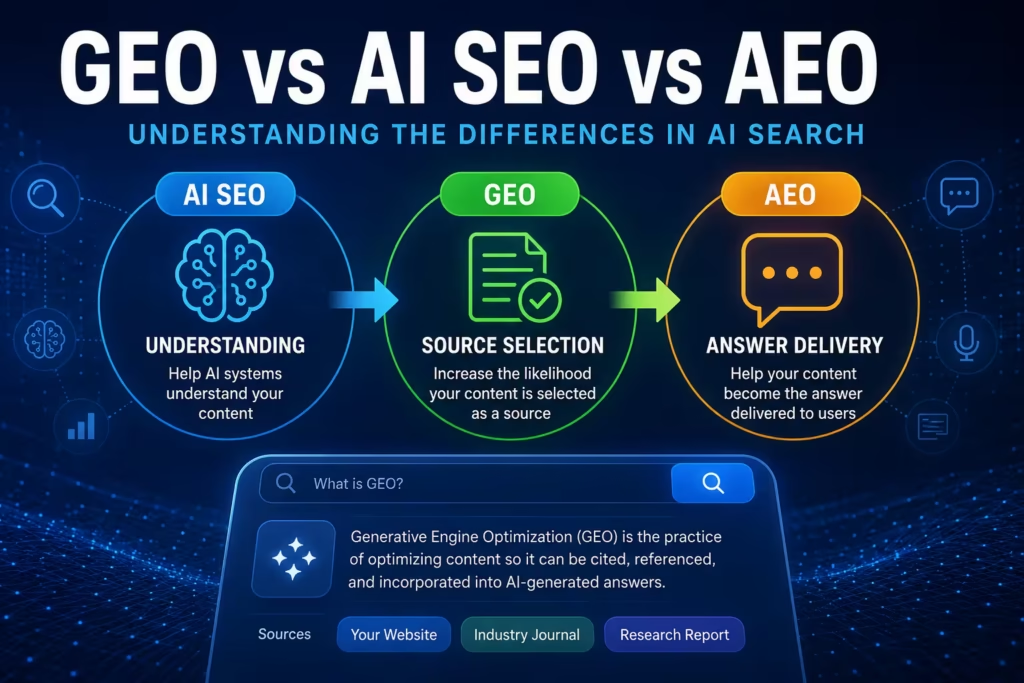
GEO vs AI SEO vs AEO: Understanding the Differences in AI Search
Search is changing rapidly, and with that change comes a growing number of new terms. Many marketers, business owners, and content creators now encounter phrases such as AI SEO, Generative Engine Optimization (GEO), and Answer Engine Optimization (AEO). Because all three are associated with artificial intelligence and modern search experiences, they are often used interchangeably.
However, these terms do not mean the same thing.
Each discipline focuses on a different aspect of how information is discovered, selected, and delivered to users. This distinction has become increasingly important as search behavior evolves beyond traditional search engines. Users now interact with AI-powered platforms, conversational search experiences, answer engines, and generative AI systems that process and present information in different ways.
As a result, businesses must think about visibility from multiple perspectives. Some strategies help AI systems understand content. Some strategies help content become a trusted source. Others help content become the direct answer presented to users.
Understanding the differences between AI SEO, GEO, and AEO helps businesses allocate resources more effectively and build a search strategy that aligns with modern search behavior.
Table of Contents
A Simple Explanation Before We Begin
If you remember only one thing from this article, remember this:
- AI SEO helps AI systems understand your content.
- GEO helps your content become a source used by AI systems.
- AEO helps your content become the answer presented to users.
Although these disciplines overlap, they serve different purposes within the modern search ecosystem.
The sections below explain how each approach works, where they differ, and how businesses can use them together to improve visibility across AI-powered search experiences.
What Is AI SEO?
AI SEO is the practice of helping AI-powered search systems understand the content, products, services, and expertise presented on a website.
The objective is not simply to improve rankings. The objective is to make it easier for intelligent search systems to determine what your website offers, who it serves, and when it should appear in relevant search experiences.
The Primary Goal of AI SEO
The primary goal of AI SEO is to improve content understanding. Before a search system can recommend a webpage, reference a resource, or surface content to users, it must first understand what the content is about.
AI SEO focuses on improving that understanding so search systems can connect the right information with the right audience.
What AI SEO Optimizes For
AI SEO is primarily concerned with helping search systems accurately interpret website content.
For example, a local accounting firm wants search systems to understand:
- The services it provides
- The industries it serves
- The problems it helps clients solve
- The expertise it demonstrates
The clearer this understanding becomes, the easier it is for search systems to evaluate when that content may be useful to users.
How Success Is Measured in AI SEO
Unlike traditional SEO, AI SEO success is not measured only by rankings.
Instead, businesses often look for signs that their content is becoming more visible and influential across AI-powered search platforms.
Common indicators include:
- More branded searches for your business
- More mentions and citations in AI-generated answers
- Growth in organic traffic from relevant topics
- Increased engagement from visitors
- More visibility for a wider range of related topics
For example, if people begin searching for your brand after seeing it mentioned in AI-generated responses, this may indicate that your AI SEO efforts are gaining traction.
For a detailed breakdown of these performance indicators, read our guide on AI SEO Strategy.
When Small Business Owners Should Focus on AI SEO
Small business owners should begin focusing on AI SEO once they have established the basic foundations of their website.
This typically includes:
- A functioning website
- Core service or product pages
- Basic technical SEO
- Initial content covering their products, services, or expertise
AI SEO should not be the first priority for a new website with little content.
Instead, it becomes increasingly important when:
- The website has published multiple pieces of content
- Search traffic has started to grow
- The business wants to expand its online visibility
- Competitors are investing in content marketing
- AI-powered search platforms are becoming a source of customer discovery
For many small businesses, AI SEO represents the next stage of search optimization after foundational SEO work has been completed.
Rather than focusing solely on rankings, the goal becomes helping AI-powered systems better understand the business, its expertise, and the information it provides.
AI SEO in One Sentence
AI SEO helps AI-powered search systems understand your website so they can determine when, where, and how your content should be presented to potential customers.
What Is GEO?
Generative Engine Optimization (GEO) is the practice of increasing the likelihood that content will be cited, referenced, or incorporated into AI-generated answers.
As AI-powered search platforms become more common, visibility is no longer limited to traditional search results. GEO focuses on helping content become a source that contributes to the answers generated by AI systems.
The Primary Goal of GEO
The primary goal of GEO is source selection. When AI platforms generate responses, they often rely on information gathered from multiple sources. GEO focuses on improving the chances that your content becomes one of those selected sources.
What GEO Optimizes For
Unlike AI SEO, which focuses on helping AI systems understand content, GEO focuses on helping content become part of AI-generated responses.
Examples include:
- AI citations
- Source references
- Brand mentions
- Inclusion in AI-generated answers
- AI referral traffic
The objective is to increase the likelihood that AI systems choose your content when responding to user questions.
How Success Is Measured in GEO
GEO success is commonly measured through:
- AI citations
- Brand mentions in AI-generated answers
- AI referral traffic
- Source references
- Citation frequency
These indicators help businesses understand whether their content is being selected and used by AI-powered platforms. For a complete introduction to this topic, see our guide on What Is GEO?
GEO in One Sentence
GEO helps your content become a source that AI systems reference, cite, and use when generating answers.
What Is AEO?
Answer Engine Optimization (AEO) is the practice of optimizing content so it can directly answer user questions across search engines, voice assistants, and AI-powered platforms.
The goal is to make information easy to extract, understand, and present as a direct answer.
The Primary Goal of AEO
The primary goal of AEO is answer delivery. When users ask a question, answer engines attempt to provide the most relevant response as quickly as possible. AEO focuses on increasing the likelihood that your content becomes that response.
What AEO Optimizes For
AEO primarily optimizes for answer visibility.
Examples include:
- Featured snippets
- AI-generated answers
- Voice search responses
- FAQ results
- Direct answer boxes
Rather than encouraging users to browse multiple pages, AEO focuses on delivering immediate answers.
How Success Is Measured in AEO
AEO success is commonly measured through:
- Featured snippet visibility
- Direct answer appearances
- Voice search visibility
- FAQ performance
- AI-generated answer inclusion
These indicators help businesses understand whether their content is being surfaced as a direct response to user questions.
AEO in One Sentence
AEO helps your content become the answer that users receive when they ask a question.
The Core Difference Between AI SEO, GEO, and AEO
Although AI SEO, GEO, and AEO are closely related, they solve different problems within the modern search ecosystem. This is why treating them as interchangeable concepts often leads to confusion.
A simple way to understand the relationship is to think of them as three different stages of visibility.
AI SEO Focuses on Understanding
Before a search engine or AI platform can use content, it must first understand what the content is about.
AI SEO focuses on helping search systems accurately interpret:
- Topics
- Expertise
- Services
- Products
- Information
Without this understanding, search systems may struggle to determine when the content is relevant.
In simple terms:
AI SEO helps search systems understand your content.
GEO Focuses on Source Selection
Once a system understands content, it must decide which sources to use when generating a response. This is where GEO comes into play. GEO focuses on increasing the likelihood that content becomes one of the sources selected to contribute information.
In simple terms:
GEO helps your content become a source.
AEO Focuses on Answer Delivery
After information has been selected, it must be presented to the user. AEO focuses on increasing the likelihood that content becomes the answer delivered to users.
This may occur through:
- AI-generated answers
- Featured snippets
- Voice search responses
- Direct answer boxes
In simple terms:
AEO helps your content become the answer.
Why These Disciplines Overlap
The three approaches support one another. A search system cannot select content it does not understand. Likewise, content is unlikely to become an answer if it is never selected as a source. This means that improvements in one area often support the others.
However, each discipline still has a different objective.
A Simple Framework
Think of the process like this:
| Stage | Objective | Discipline |
|---|---|---|
| Understand the content | Determine what the content is about | AI SEO |
| Select the source | Decide which information to use | GEO |
| Deliver the answer | Present information to the user | AEO |
This framework helps explain why all three disciplines have become increasingly important as AI-powered search continues to evolve.
The Key Takeaway
AI SEO, GEO, and AEO are not competing strategies.
They represent different stages of how information moves from a website to a user.
- AI SEO helps systems understand content.
- GEO helps content become a selected source.
- AEO helps content become the delivered answer.
Businesses that understand these distinctions can make more informed decisions about where to focus their optimization efforts.
AI SEO vs GEO vs AEO Comparison Table
The easiest way to understand the relationship between AI SEO, GEO, and AEO is to compare them side by side.
Although the three disciplines overlap, each one focuses on a different objective within the search ecosystem.
Comparison by Primary Goal
| Discipline | Primary Goal |
|---|---|
| AI SEO | Help AI systems understand content |
| GEO | Help content become a selected source |
| AEO | Help content become the answer delivered to users |
Comparison by Core Question
| Discipline | Core Question |
|---|---|
| AI SEO | Does the system understand the content? |
| GEO | Will the system use this source? |
| AEO | Will this information become the answer? |
Comparison by Visibility Type
| Discipline | Visibility Focus |
|---|---|
| AI SEO | AI-powered search visibility |
| GEO | AI citations and references |
| AEO | Direct answers and answer boxes |
Comparison by Success Metrics
| Discipline | Common Metrics |
|---|---|
| AI SEO | Branded searches, topic visibility, relevant traffic |
| GEO | AI citations, source references, AI referral traffic |
| AEO | Featured snippets, answer box appearances, voice search visibility |
Comparison by Search Experience
| Discipline | Primary Environment |
|---|---|
| AI SEO | AI-powered search platforms |
| GEO | Generative AI platforms |
| AEO | Search engines, voice assistants, AI answer engines |
Comparison by User Interaction
| Discipline | User Experience |
|---|---|
| AI SEO | Users discover relevant content |
| GEO | Users encounter information from cited sources |
| AEO | Users receive a direct answer immediately |
Comparison by Business Objective
| Discipline | Business Outcome |
|---|---|
| AI SEO | Improve content understanding and discoverability |
| GEO | Increase source visibility and influence |
| AEO | Increase answer visibility and brand exposure |
Comparison at a Glance
| Category | AI SEO | GEO | AEO |
|---|---|---|---|
| Focus | Understanding | Source Selection | Answer Delivery |
| Goal | Improve interpretation | Earn citations | Earn answers |
| Visibility Type | Search visibility | Citation visibility | Answer visibility |
| Success Indicator | Relevant discovery | Source usage | Direct answer appearance |
| User Journey Stage | Understanding | Selection | Delivery |
The Key Takeaway
AI SEO, GEO, and AEO are not competing approaches. They address different stages of how information moves through modern search systems.
- AI SEO focuses on understanding.
- GEO focuses on selection.
- AEO focuses on delivery.
Together, they create a more complete framework for improving visibility across AI-powered search experiences.
A Practical Example: How AI SEO, GEO, and AEO Work Together
Understanding definitions is helpful, but seeing how AI SEO, GEO, and AEO interact in a real search scenario makes the differences easier to understand.
Let’s look at a simple example.
Scenario: A User Searches for “What Is GEO?”
A business owner wants to learn about Generative Engine Optimization and enters the query:
What is GEO?
Behind the scenes, several processes occur before an answer is delivered.
How AI SEO Contributes
The first challenge is understanding the content.
The search system must determine:
- Which pages discuss GEO
- Which sources provide relevant information
- Which content accurately explains the topic
This is where AI SEO plays a role.
Content that clearly explains GEO, uses relevant terminology, and covers the topic comprehensively is easier for AI systems to interpret and classify. Without this stage, the search system may struggle to identify which content is relevant to the query.
How GEO Contributes
Once relevant content has been identified, the system must decide which sources to use. Not every article discussing GEO will contribute to the final response.
The system may evaluate:
- Relevance
- Credibility
- Freshness
- Clarity
- Source usefulness
At this stage, GEO becomes important.
The objective is to increase the likelihood that your article is selected as one of the sources used to generate the response.
How AEO Contributes
After information has been selected, the system must present an answer to the user. This is where AEO becomes important. The goal is to provide information in a format that can be delivered directly as an answer.
For example:
Generative Engine Optimization (GEO) is the practice of optimizing content so it can be cited, referenced, and incorporated into AI-generated answers.
This concise definition is easier to surface than a lengthy explanation buried several paragraphs into an article.
What This Example Teaches Us
The three disciplines support different stages of the same process.
AI SEO helps the system understand content. GEO helps the content become a selected source. AEO helps the information become the answer delivered to the user.
Remove any one of these stages, and visibility opportunities become more limited.
A Simple Visualization
| Stage | What Happens? | Discipline |
|---|---|---|
| Content is interpreted | The system identifies relevant information | AI SEO |
| Sources are selected | The system chooses information sources | GEO |
| Answer is delivered | The system presents a response to the user | AEO |
The Key Takeaway
AI SEO, GEO, and AEO should not be viewed as separate competing strategies. They work together throughout the journey from content creation to answer delivery.
Understanding how these stages interact can help businesses build a more complete approach to search visibility in an increasingly AI-driven landscape.
Which Strategy Should You Prioritize?
Choosing between AI SEO, GEO, and AEO depends on your goals, website maturity, and the type of visibility you want to achieve. Use the frameworks below to identify where to focus first.
If Your Goal Is…
Your primary objective often determines which strategy deserves the most attention. The table below maps common goals to the approach most likely to support them.
| Goal | Priority |
|---|---|
| Help AI systems understand your website | AI SEO |
| Increase citations in AI-generated answers | GEO |
| Appear as a direct answer to questions | AEO |
| Improve visibility across AI-powered search | AI SEO + GEO |
| Earn featured snippets and answer boxes | AEO |
| Increase brand mentions in AI responses | GEO |
| Build long-term AI search visibility | AI SEO + GEO + AEO |
For example, if your biggest challenge is helping AI systems interpret your content correctly, AI SEO should be your starting point. If your goal is to be cited or referenced in AI-generated responses, GEO becomes more important. Businesses seeking comprehensive AI search visibility often benefit from combining multiple approaches.
For Small Business Owners
Small businesses often have limited resources, so prioritization matters. Your website’s current stage can help determine where to focus first.
| Situation | Recommended Focus |
|---|---|
| New website | AI SEO |
| Growing content library | AI SEO + GEO |
| Established authority website | GEO |
| FAQ-heavy website | AEO |
| Local service business | AI SEO + AEO |
| Content-driven business | AI SEO + GEO |
| Publisher or media website | GEO + AEO |
A new website typically benefits most from AI SEO because search systems first need to understand its content and expertise. As your content library grows, GEO can help increase citations and visibility in AI-generated responses. Businesses with extensive FAQs or educational content may see stronger results from AEO.
By Website Type
Different website models have different visibility goals. The table below provides a practical starting point based on your business type.
| Website Type | First Priority | Second Priority |
|---|---|---|
| Local Business | AI SEO | AEO |
| Ecommerce Store | AI SEO | GEO |
| SaaS Company | AI SEO | GEO |
| Agency Website | GEO | AI SEO |
| Publisher | GEO | AEO |
| Blog | AI SEO | GEO |
| Nonprofit Organization | AI SEO | AEO |
For example, ecommerce and SaaS websites often need strong AI SEO foundations before pursuing broader AI citations through GEO. Publishers and media sites, on the other hand, may benefit more from GEO because their content is frequently referenced as a source in AI-generated answers.
Quick Decision Framework
If you’re still unsure where to begin, use these simple guidelines.
Start with AI SEO if:
- Search systems struggle to understand your content
- Your website lacks topical coverage
- Your content strategy is still developing
AI SEO is usually the best starting point because it creates the foundation that allows AI systems to interpret, categorize, and trust your content.
Focus on GEO if:
- You want more AI citations
- You want more brand mentions
- You want to influence AI-generated answers
GEO becomes valuable when your content is already established and you want AI systems to reference it more frequently in generated responses.
Focus on AEO if:
- You target question-based searches
- You rely heavily on informational content
- You want to appear in direct answers
AEO is particularly effective for websites that answer common questions and want to become the preferred response in search and AI interfaces.
The Simplest Rule
If you only remember one framework, use this one.
| Situation | Priority |
|---|---|
| Need better understanding | AI SEO |
| Need more citations | GEO |
| Need more answers | AEO |
Think of AI SEO as helping AI systems understand your content, GEO as helping them cite your content, and AEO as helping them use your content as the answer.
The Key Takeaway
Most businesses should not choose only one strategy. AI SEO provides the foundation. GEO helps content become a source. AEO helps content become the answer.
The most effective long-term approach is understanding when each discipline should be applied and how they support one another.
Common Misconceptions About AI SEO, GEO, and AEO
As AI-powered search continues to evolve, new terminology has entered the SEO industry. Unfortunately, this has also created confusion. Many marketers and business owners misunderstand how AI SEO, GEO, and AEO relate to one another, which can lead to ineffective optimization efforts and unrealistic expectations.
The following misconceptions are among the most common.
Misconception #1: GEO Replaces SEO
One of the most common misunderstandings is that GEO will eventually replace traditional SEO. In reality, GEO builds upon the foundation established by SEO. Websites still need to be discoverable, accessible, and relevant before they can become sources within AI-generated responses.
GEO expands visibility opportunities, but it does not eliminate the need for traditional search optimization.
Misconception #2: AI SEO and GEO Are the Same Thing
Although AI SEO and GEO are closely related, they focus on different objectives.
AI SEO focuses on helping AI-powered systems understand content. GEO focuses on increasing the likelihood that content is selected as a source for AI-generated answers.
A website may perform well in AI SEO while still having limited citation visibility if GEO is not considered.
Misconception #3: AEO Is Only About FAQ Pages
Many people associate AEO exclusively with FAQ sections. While FAQs can support answer visibility, AEO extends beyond question-and-answer formats.
Definitions, comparisons, step-by-step instructions, tables, and concise explanations can also contribute to answer visibility across modern search experiences.
Misconception #4: You Must Choose Only One Strategy
Some businesses assume they must choose between AI SEO, GEO, and AEO. In practice, the three approaches often complement one another.
AI SEO improves understanding.
GEO increases source visibility.
AEO improves answer visibility.
Together, they support different stages of the search journey.
Misconception #5: AI Search Makes Traditional SEO Obsolete
AI-powered search is changing how users discover information, but traditional SEO remains important. Many AI systems still rely on information gathered from websites that have been optimized for search.
Rather than replacing SEO, AI search is creating additional opportunities for visibility.
The Key Takeaway
AI SEO, GEO, and AEO are not competing replacements for traditional SEO. They represent different approaches to improving visibility across modern search environments.
Understanding their individual roles can help businesses make better decisions about where to focus their optimization efforts.
Frequently Asked Questions
Is GEO the Same as AI SEO?
No.
AI SEO focuses on helping AI-powered systems understand and interpret content.
GEO focuses on increasing the likelihood that content is cited, referenced, or used as a source in AI-generated answers.
While the two disciplines overlap, they serve different purposes within the search ecosystem.
What Is the Difference Between GEO and AEO?
GEO focuses on becoming a source. AEO focuses on becoming the answer.
For example, an article may be referenced by an AI system as a source through GEO, while a concise definition from that same article may be presented directly to users through AEO.
Which Is More Important: AI SEO, GEO, or AEO?
There is no universal answer. The right priority depends on your goals.
AI SEO is important when improving content understanding. GEO is important when increasing citations and references. AEO is important when targeting direct answers and question-based searches.
Many businesses benefit from using all three approaches together.
Should Small Businesses Care About GEO?
Yes.
AI-powered search experiences are becoming more common, and small businesses can benefit when their content is cited or referenced in AI-generated answers.
GEO helps increase opportunities for this type of visibility.
Does Traditional SEO Still Matter?
Absolutely.
Traditional SEO remains the foundation of online visibility.
AI SEO, GEO, and AEO do not replace SEO. Instead, they build upon many of the principles that have supported search visibility for years.
Can One Piece of Content Support AI SEO, GEO, and AEO?
Yes.
A well-structured article can help AI systems understand a topic, contribute information to AI-generated responses, and provide concise answers to user questions.
This allows a single piece of content to support multiple visibility objectives.
Which Strategy Should I Start With?
For most websites, AI SEO is the best starting point because it establishes a foundation for how search systems interpret content. Once that foundation is in place, GEO and AEO can help expand visibility through citations, references, and direct answers.
Will GEO Become More Important in the Future?
As AI-generated search experiences continue to grow, GEO is likely to become increasingly important.
Businesses that understand how content becomes a source within AI-generated answers may be better positioned to maintain visibility as search evolves.
Conclusion
AI-powered search has introduced new ways for users to discover information, creating new opportunities for businesses to improve their visibility online.
As a result, terms such as AI SEO, GEO, and AEO have become increasingly important. While these disciplines are closely related, they are not the same. AI SEO focuses on helping AI-powered systems understand content. GEO focuses on increasing the likelihood that content is selected as a source for AI-generated answers. AEO focuses on helping content become the answer delivered directly to users.
Understanding these distinctions can help businesses prioritize their efforts more effectively and avoid treating all AI search optimization strategies as a single discipline. Rather than viewing AI SEO, GEO, and AEO as competing approaches, it is more useful to view them as complementary parts of a modern search strategy.
Businesses that understand how content is interpreted, selected, and presented will be better positioned to maintain visibility as search continues to evolve.
The future of search is not limited to rankings alone. It increasingly includes citations, references, direct answers, and AI-generated experiences. Understanding where AI SEO, GEO, and AEO fit within that landscape is the first step toward building a more effective search strategy.

Tenzin Tashi is an SEO and WordPress FSE web design specialist at Tenz Digital. He focuses on on-page and technical SEO, keyword research, and building SEO-friendly websites using modern analytics tools.