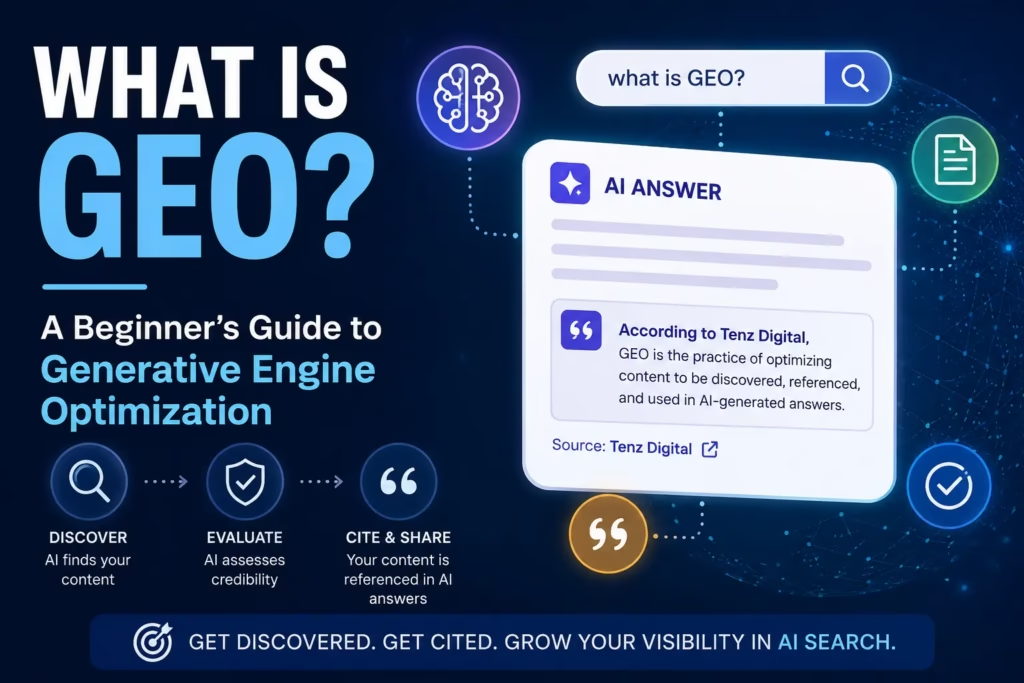
What Is GEO? A Beginner’s Guide to Generative Engine Optimization
For more than two decades, search engine optimization focused on helping websites rank higher in search results. Today, a new challenge is emerging.
Millions of users are increasingly turning to AI-powered platforms to ask questions, compare solutions, research products, and discover information. Instead of browsing multiple webpages, users often receive a single AI-generated response that summarizes information from multiple sources.
This shift changes how visibility is earned. In traditional search, success often meant ranking on the first page.
In AI-powered search environments, success increasingly means becoming a source that AI systems choose to reference, cite, or incorporate into generated answers. This is where Generative Engine Optimization (GEO) comes in.
GEO focuses on helping content become discoverable, trustworthy, and useful within AI-generated responses. As AI-powered search continues to evolve, businesses that understand GEO will be better positioned to maintain visibility and influence across emerging search experiences.
Table of Contents
What Is GEO?
Generative Engine Optimization (GEO) is the practice of optimizing content so it can be discovered, referenced, cited, and incorporated into AI-generated answers.
Unlike traditional SEO, which focuses primarily on improving rankings in search results, GEO focuses on increasing the likelihood that AI-powered systems will use your content when generating responses to user questions.
If you’re new to AI-powered search optimization, start with our guide on What Is AI SEO? to understand how search engines and AI systems interpret and surface content.
GEO Explained in Simple Terms
Think of traditional SEO as competing for a position in a list of search results. Think of GEO as competing to become a trusted source within an AI-generated answer.
For example, when a user asks:
What is the best way to improve website performance?
An AI-powered system may generate a response using information gathered from multiple sources. The websites that contribute information to that answer have achieved GEO visibility, regardless of whether the user ever sees a traditional search results page.
Why GEO Matters in 2026
User behavior is changing rapidly.
People increasingly use AI-powered platforms to:
- Research topics
- Compare products
- Learn new skills
- Find recommendations
- Solve problems
In many cases, users receive answers directly from AI systems rather than clicking through multiple webpages. This creates a new visibility opportunity. Businesses that optimize for GEO can increase the likelihood that their expertise, content, and insights become part of these AI-generated experiences.
Visibility alone is not enough. Businesses also need to understand how to measure AI search performance. Our AI SEO Strategy guide explains the key signals that indicate growing visibility across AI-powered search experiences.
GEO at a Glance
| Traditional SEO | GEO |
|---|---|
| Focuses on rankings | Focuses on citations and references |
| Optimizes webpages | Optimizes information sources |
| Measures traffic | Measures AI visibility |
| Competes for clicks | Competes for inclusion in answers |
| Search result focused | AI response focused |
The Core Goal of GEO
The primary goal of GEO is not simply to attract clicks. The goal is to ensure that AI-powered systems recognize your content as a credible source of information when generating answers. The more frequently your content is selected as a reference, the greater your potential visibility across AI-powered search experiences.
Key Takeaway
Generative Engine Optimization is the practice of making content easier for AI systems to discover, trust, reference, and incorporate into generated answers. As search evolves beyond traditional rankings and links, GEO is becoming an increasingly important component of digital visibility.
How Is GEO Different From Traditional SEO?
Generative Engine Optimization (GEO) and Search Engine Optimization (SEO) both aim to improve online visibility, but they operate in different environments. Traditional SEO focuses on helping webpages appear in search results. GEO focuses on helping content become part of AI-generated answers.
As AI-powered search experiences become more common, understanding this distinction is increasingly important.
Businesses often confuse GEO and AI SEO. Although they overlap, AI SEO focuses on helping AI systems understand content, while GEO focuses on increasing the likelihood that content will be cited and referenced in AI-generated answers. Learn more in our What Is AI SEO? guide.
Traditional SEO vs GEO
| Traditional SEO | GEO |
|---|---|
| Optimizes for search engine results pages (SERPs) | Optimizes for AI-generated responses |
| Success is often measured through rankings and clicks | Success is often measured through citations, references, and mentions |
| Users choose which result to visit | AI systems choose which sources to use |
| Visibility comes from appearing in search results | Visibility comes from being included in generated answers |
| Focuses on webpage performance | Focuses on source selection and information quality |
While both disciplines share some foundational principles, their objectives are different.
Rankings vs Citations
Traditional SEO is heavily influenced by rankings. For example, if a page ranks first for a keyword, it often receives more visibility and traffic than lower-ranking pages.
GEO introduces a different dynamic. AI systems do not simply present a ranked list of webpages. Instead, they generate responses using information gathered from multiple sources. As a result, a website can influence an AI-generated answer even if a user never visits the page directly.
In GEO, being cited can be just as valuable as being clicked.
Traffic vs Influence
Traditional SEO often focuses on attracting website visitors. GEO introduces a broader concept: influence.
A brand, article, study, or expert opinion may shape an AI-generated answer even when it does not receive immediate traffic.
This means businesses should think beyond pageviews and consider how their content contributes to conversations happening across AI-powered platforms.
Search Results vs Generated Answers
In traditional search, users typically review multiple results before choosing a source. In AI-powered search environments, users often receive a synthesized answer immediately. This changes the competitive landscape.
Instead of competing solely for rankings, businesses increasingly compete to become one of the trusted sources that AI systems use to construct answers.
A Practical Example
Imagine a user asks:
What are the benefits of GEO for businesses?
In a traditional search environment, Google may display ten blue links. The user chooses which result to click.
In an AI-powered environment, the system may generate a direct answer using information from several sources. The sources that contributed information have achieved GEO visibility because their content influenced the final response.
Why Businesses Should Care About GEO
The growth of AI-powered search does not mean traditional SEO is disappearing. However, it does mean that visibility is expanding beyond search rankings.
Businesses that understand GEO can position themselves to benefit from both:
- Traditional search visibility
- AI-generated visibility
This creates more opportunities for expertise, research, and insights to reach potential customers.
The Key Takeaway
Traditional SEO helps content appear in search results. GEO helps content become part of AI-generated answers.
As search behavior continues to evolve, businesses that understand both disciplines will be better prepared to maintain visibility across the full spectrum of modern search experiences.
How Do Generative AI Engines Find and Use Information?
To understand GEO, it is important to understand how generative AI engines produce answers. Unlike traditional search engines, which primarily return a list of webpages, generative AI systems create responses by gathering, evaluating, and synthesizing information from multiple sources.
This process determines which content becomes visible within AI-generated answers.
How Generative AI Engines Work
At a high level, generative AI engines follow a three-step process:
- Find relevant information.
- Evaluate source usefulness and credibility.
- Generate a response using selected information.
The goal is not simply to locate matching keywords. Instead, the system attempts to provide the most useful answer to the user’s question.
Step 1: Information Retrieval
Before an AI system can generate an answer, it must identify information that may help answer the query.
For example, if a user asks:
What is Generative Engine Optimization?
the system searches for content that discusses:
- GEO
- AI search visibility
- AI citations
- Source selection
- AI-generated answers
This stage is often called retrieval because the system is retrieving potentially useful information before generating a response.
Step 2: Source Evaluation
Not every source has the same chance of influencing an AI-generated answer.
Generative AI systems often evaluate factors such as:
- Relevance
- Accuracy
- Clarity
- Freshness
- Expertise
- Consistency
Content that answers a question directly and clearly is generally easier for AI systems to use than content that is vague or overly promotional.
Step 3: Response Generation
After identifying useful information, the AI system generates a response. Rather than copying an entire webpage, it typically combines information from multiple sources into a single answer. This means that a single AI-generated response may be influenced by several different websites, articles, studies, and expert opinions.
Why Some Content Gets Used More Often
Many website owners assume AI systems simply select the highest-ranking page. In reality, source selection is often more nuanced.
Content is more likely to be referenced when it:
- Answers a question directly
- Provides clear explanations
- Uses credible information
- Covers a topic comprehensively
- Demonstrates expertise
- Remains current
The easier content is to interpret and trust, the easier it becomes for AI systems to incorporate it into generated answers.
What Makes Information Easy to Use?
Generative AI engines often favor content that is structured clearly.
Examples include:
- Definitions
- Step-by-step explanations
- Comparison tables
- FAQs
- Frameworks
- Checklists
These formats help AI systems quickly identify important information and understand how different concepts relate to one another.
Source Selection Is Not the Same as Ranking
One of the biggest misconceptions about GEO is that ranking first automatically guarantees AI visibility. While strong search visibility can help, AI systems may reference information from a variety of sources depending on the question being asked.
A highly relevant and well-structured source can sometimes contribute to an answer even when it is not the most visible result in traditional search. This is one reason GEO has become an increasingly important discipline.
The Key Takeaway
Generative AI engines do more than retrieve webpages. They identify relevant information, evaluate potential sources, and generate answers using selected content.
GEO helps businesses increase the likelihood that their expertise, research, and insights become part of this process. The better a source answers questions and communicates information, the more likely it is to influence AI-generated responses.
What Factors Influence GEO Visibility?
Not all content has the same chance of being referenced in AI-generated answers. When generative AI systems evaluate information, they look for sources that are useful, trustworthy, and easy to incorporate into responses.
While the exact methods vary across platforms, several factors consistently increase the likelihood that content will be selected and referenced.
Content Clarity
AI systems perform best when information is presented clearly. Content that directly answers questions is often easier to understand than content filled with unnecessary jargon or vague explanations.
For example:
GEO helps content become a source for AI-generated answers.
is easier to interpret than:
GEO represents a multidimensional optimization methodology for enhancing algorithmic content accessibility.
Clear explanations improve both human comprehension and AI usability.
Direct Answer Availability
Generative AI engines frequently look for content that answers questions efficiently.
Pages that provide:
- Definitions
- Explanations
- Comparisons
- Step-by-step instructions
are often easier to use during answer generation.
This is one reason FAQs, definition blocks, and structured explanations frequently appear in AI-cited content.
Source Credibility
AI systems attempt to identify sources that demonstrate credibility and expertise.
Signals may include:
- Author expertise
- Original research
- Industry experience
- Consistent publication quality
- Reliable factual information
Content that demonstrates genuine expertise is generally more useful than content created solely to attract traffic.
Information Freshness
Some topics change rapidly.
Examples include:
- Search engine optimization
- Artificial intelligence
- Digital marketing
- Technology
AI systems often seek the most current information available when answering questions related to evolving industries. Regular content updates help maintain relevance.
Original Insights and Unique Perspectives
Many websites publish similar information. When dozens of articles repeat the same advice, there is little reason for an AI system to prefer one source over another.
Content becomes more valuable when it includes:
- Original observations
- Proprietary frameworks
- Industry experience
- Case studies
- Unique examples
These elements help differentiate a source from competing content.
Structured Information
Information that follows a logical structure is easier for AI systems to process.
Examples include:
- Comparison tables
- Checklists
- Frameworks
- Numbered processes
- Frequently asked questions
Structured information helps AI systems identify key points quickly and accurately.
Topical Consistency
Sources that consistently publish information within a specific subject area often develop stronger associations with that topic.
For example, a website that regularly publishes content about:
- SEO
- GEO
- AI search
- Content strategy
may be viewed as a more specialized source than a website covering unrelated topics. Consistency helps establish subject-matter relevance over time.
Citation-Worthy Content
Some content formats naturally lend themselves to citations.
Examples include:
- Definitions
- Statistics
- Research findings
- Frameworks
- Original methodologies
When AI systems need concise information, these formats are often easier to reference than long narrative sections.
Why GEO Visibility Cannot Be Guaranteed
Unlike traditional rankings, GEO visibility is not controlled by a single position in search results.
AI-generated answers are influenced by:
- The question being asked
- Available information
- Source quality
- Context
- Platform-specific systems
As a result, no website can guarantee inclusion in AI-generated responses.
The objective of GEO is to increase the likelihood that your content becomes a useful source when relevant questions are asked.
The Key Takeaway
GEO visibility is influenced by how useful, trustworthy, clear, and reference-worthy content appears to AI systems.
Businesses that create direct answers, maintain high-quality information, publish original insights, and structure content effectively are more likely to become sources that contribute to AI-generated responses.
Once your content begins appearing in AI-generated answers, the next challenge is measuring impact. Learn how to evaluate emerging AI search signals in our AI SEO Strategy guide.
How to Optimize Content for GEO
Understanding GEO is important, but visibility in AI-generated answers requires deliberate optimization. The goal is not to manipulate AI systems. The goal is to create content that is easier to discover, understand, verify, and reference when answering user questions.
The following practices can help improve the likelihood that your content contributes to AI-generated responses.
Structure Content Around User Intent
AI systems are designed to answer questions, solve problems, and provide context. Instead of focusing solely on keywords, build content around the topics and questions your audience is actually asking.
Examples include:
- What is GEO?
- How does GEO work?
- Is GEO different from SEO?
- What are the benefits of GEO?
When content aligns closely with user intent, AI systems can more easily identify relevant information and surface it in responses.
Make Key Information Easy to Extract
AI-generated answers often rely on content that presents information clearly and concisely.
Important concepts should be easy to identify without requiring readers—or AI systems—to search through lengthy introductions.
For example:
Generative Engine Optimization (GEO) is the practice of optimizing content so it can be discovered, referenced, and incorporated into AI-generated answers.
Providing direct explanations early in the content improves accessibility and increases the likelihood of accurate interpretation.
Use Structured Formats
Well-structured content is easier for both humans and AI systems to process.
Consider incorporating formats such as:
- Definitions
- Step-by-step processes
- Checklists
- Comparison tables
- Frameworks
- FAQs
For example:
| SEO | GEO |
|---|---|
| Focuses on rankings | Focuses on citations |
| Measures clicks | Measures AI visibility |
| Search result focused | AI answer focused |
Structured formats help organize information into clearly defined sections that can be referenced more easily.
Demonstrate Credibility and Expertise
AI systems increasingly prioritize content that appears trustworthy and well-supported.
Whenever possible, strengthen your content with:
- Research findings
- Industry data
- Original observations
- Practical examples
- Case studies
Supporting claims with evidence helps establish authority and improves the overall usefulness of the content.
Publish Original Insights
One of the most effective ways to stand out is to contribute information that is not widely available elsewhere.
Examples include:
- Proprietary frameworks
- Original research
- Unique methodologies
- Industry benchmarks
- First-hand experience
For example:
- The Tenz Digital GEO Framework
- The GEO Visibility Model
- The AI Citation Pyramid
Original insights give AI systems distinctive information to reference and can increase the likelihood of citations.
Improve Content Organization
Logical organization helps readers understand information quickly and helps AI systems interpret relationships between concepts.
A common structure might include:
- Definition
- Explanation
- Example
- Implementation
- Key Takeaway
Clear progression reduces ambiguity and makes content easier to navigate.
Keep Content Accurate and Current
AI search experiences evolve rapidly, and outdated information can reduce content quality.
Regular updates help ensure that:
- Definitions remain accurate
- Statistics stay current
- Examples remain relevant
- Best practices reflect recent developments
Maintaining fresh content improves reliability and long-term usefulness.
Prioritize Clarity Over Optimization Tactics
The strongest GEO strategies focus on helping people understand information.
Content should be written so that:
- Readers can find answers quickly
- Concepts are explained clearly
- Key points are easy to identify
- Information can be trusted and referenced confidently
When content is genuinely useful, it becomes easier for AI systems to incorporate it into generated responses.
The GEO Optimization Checklist
Before publishing content, ask:
✓ Does the content address a clear user question or intent?
✓ Is the primary concept defined clearly?
✓ Are important points presented in a structured format?
✓ Are examples, tables, frameworks, or checklists included where helpful?
✓ Are claims supported by evidence, data, or experience?
✓ Is the content organized logically?
✓ Has the information been reviewed for accuracy and relevance?
The Key Takeaway
GEO is ultimately about making information easier to understand, verify, and reference. Content that aligns with user intent, presents information clearly, demonstrates credibility, and offers unique value is more likely to be discovered and cited within AI-generated responses.
The easier your content is to interpret and trust, the greater its potential visibility across AI-powered search experiences.

Tenzin Tashi is an SEO and WordPress FSE web design specialist at Tenz Digital. He focuses on on-page and technical SEO, keyword research, and building SEO-friendly websites using modern analytics tools.